
Is Buddhism Declining? What Pew’s Latest Population Projections Really Tell Us
Pew Research Center projects that the global Buddhist population will decline by 74 million by 2070. But measuring religious identity, particularly in East Asia, presents challenges that complicate the picture.
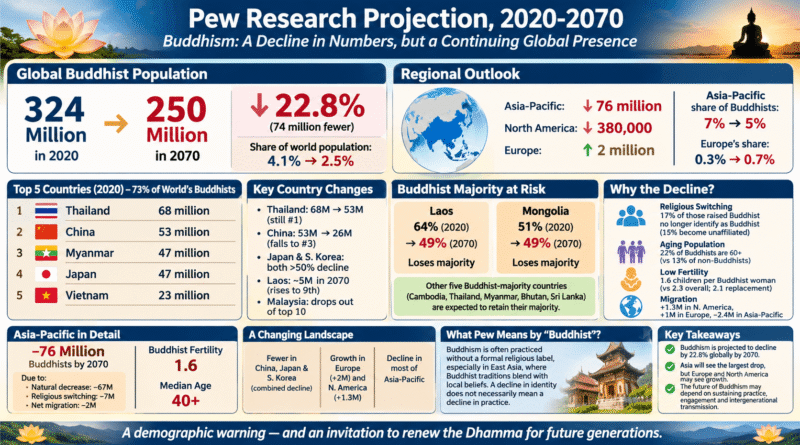
November 20, 2026 The global Buddhist population is projected to decline from 324 million in 2020 to 250 million by 2070, according to a new report released by the Pew Research Center on November 18. Buddhists are expected to make up just 2.5 percent of the world’s population by then, down from 4.1 percent in 2020.
The projections point to a continuing demographic decline, particularly in East Asia, where aging populations, low fertility rates and religious disaffiliation are contributing to the trend. However, the figures also raise questions about how religious identity is measured and whether population statistics capture the full extent of Buddhist participation.
Where Is the Decline Happening?
According to Pew Research, approximately 98 percent of the world’s Buddhists lived in the Asia-Pacific region in 2020. The region is projected to lose approximately 76 million Buddhists by 2070.
China, Japan and South Korea are expected to experience the most substantial reductions, with their Buddhist populations projected to fall by more than half. China’s Buddhist population is projected to decline from 53 million to 26 million by 2070. Thailand, which has the world’s largest Buddhist population, is expected to have approximately 14 million fewer Buddhists by 2070.
Pew also projects that Buddhism will no longer constitute a majority religion in Mongolia or Laos by the end of the period.
The decline is not uniform across the world. Buddhist populations in several other regions are expected to remain relatively stable or grow modestly, but these increases will not offset the projected losses in Asia.
Why Are Buddhist Numbers Declining?
Several demographic factors help explain the trend.
Buddhist populations tend to be older than those of some other major religious groups and have relatively low fertility rates. According to Pew’s estimates for 2020–2025, Buddhists have a global total fertility rate of 1.6 children per woman, compared with 3.1 among Muslims.
An older population and fewer births mean fewer young people entering the population.
Religious disaffiliation, when people raised in a particular religion no longer identify with it, adds to the decline in some countries.
Pew’s projections incorporate differences in fertility, mortality, migration and religious switching. They assume that recently observed demographic patterns will continue over the coming decades.
The Challenge of Counting Buddhists
One important qualification in Pew’s report concerns how people identify their religion.
The 2020 estimates are based primarily on national censuses and surveys that ask respondents about their religious identity, often through a question such as, “What is your religion, if any?”
But in China, Japan, South Korea and Vietnam, religious identity does not always correspond to religious practice. A similar pattern may also exist in other Asian countries. One member of our editorial team, originally from Nepal, observes that this can also be seen among some Nepalese Buddhists.
Many people who do not formally identify as Buddhist may visit Buddhist temples, make offerings to the Buddha, observe Buddhist festivals or participate in Buddhist rituals. Buddhism is also closely connected with local folk traditions, making the boundaries between religious identities less distinct.
Pew acknowledges that surveys based on formal religious identification may not capture everyone who participates in Buddhist beliefs and practices. Counting people who identify themselves as Buddhist is not necessarily the same as measuring the number of people who participate in Buddhist religious life.
Consequently, the projected decline in formally identified Buddhists should not automatically be interpreted as an equivalent decline in Buddhist practice or cultural influence.
What Do the Projections Really Tell Us?
Pew’s research provides valuable evidence of demographic challenges facing Buddhist communities, particularly in historically Buddhist societies in East Asia.
However, the 2070 figures are projections based on current data and assumptions, not certainties. Changes in fertility, migration, religious affiliation and social conditions could produce different outcomes. Pew also notes that major events such as wars, epidemics and natural disasters could affect future populations.
Population statistics also have limitations in measuring the broader influence of Buddhism. They do not capture everyone who studies Buddhist philosophy, practices meditation or engages with Buddhist teachings without formally identifying as Buddhist. The findings therefore offer an important picture of changing religious demographics, but not a complete account of Buddhism’s position in the world.
How Reliable Are the Buddhist Population Estimates?
Pew’s earlier estimates also illustrate why these projections should be interpreted with caution. In its 2015 projections, Pew estimated that there were 488 million Buddhists worldwide in 2010. Its 2025 reassessment revised that figure to 343 million, a difference of 145 million, largely reflecting methodological changes, particularly in measuring religious identity in China.
This was not an actual loss of Buddhists, but a substantial revision of how the population was counted. The experience demonstrates how changes in data and methodology can influence demographic estimates, making long-term projections informative indicators rather than definitive predictions.
Pew’s projections deserve attention, but they should be understood as estimates based on current demographic trends rather than definitive predictions of Buddhism’s future. The substantial revision of earlier population estimates also illustrates the challenges of measuring religious identity, particularly in societies where religious affiliation and practice do not always coincide.
Sources
1. Pew Research Center, November 18, 2026. The Future of the Global Buddhist Population, 2020–2070
2. Pew Research Center, November 18, 2026. Key Factors Shaping the Global Future of Religions
3. Pew Research Center, November 18, 2026. The Future of World Religions: Population Growth Projections, 2020–2070.