
Report: Understanding the Global Decline of Buddhism
A recent study by the Pew Research Center highlights a notable global trend: Buddhism is the only major religion that experienced a decline in followers between 2010 and 2020. While the world’s population and other religious groups expanded during this decade, the number of Buddhists decreased both numerically and proportionally. This report explores the underlying causes of this shift, focusing on demographic patterns, regional dynamics, and changes in religious identity.
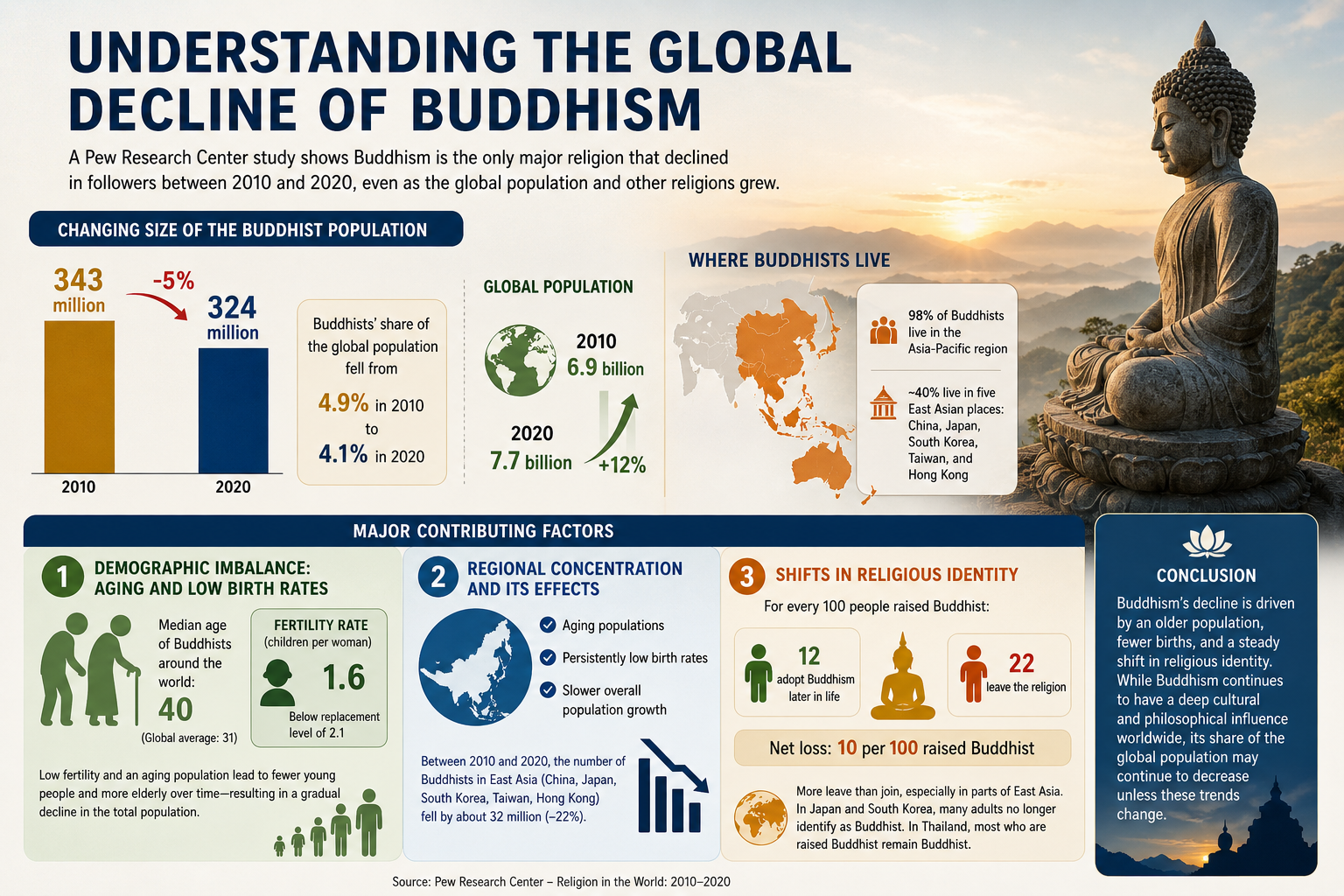
At the beginning of the decade, roughly 343 million people worldwide identified as Buddhists. By 2020, that number had dropped to about 324 million, marking a decline of around 5%. In contrast, the global population grew by approximately 12% over the same period.
Because of this divergence, Buddhism’s share of the global population fell from 4.9% to 4.1%. This indicates not just a decrease in total followers, but also a relative decline compared to other major religions.
Major Contributing Factors
1. Demographic Imbalance: Aging and Low Birth Rates
One of the most important factors behind this trend is the age structure of Buddhist populations.
Globally, Buddhists tend to be older than followers of other major religions. With a median age of about 40, they are significantly older than the global average. At the same time, Buddhist communities have the lowest fertility rates, averaging about 1.6 children per woman—well below the replacement level required to sustain population size.
This combination leads to a gradual demographic contraction. Fewer births mean smaller younger generations, while a larger share of the population moves into older age groups. Over time, this imbalance results in a natural decline in total population.
2. Regional Concentration and Its Effects
Buddhism is not evenly distributed across the globe. Nearly all Buddhists live in the Asia-Pacific region, with a large proportion concentrated in East Asia—particularly in China, Japan, South Korea, Taiwan, and Hong Kong.
These areas share several demographic characteristics:
- Aging populations
- Persistently low birth rates
- Slower overall population growth
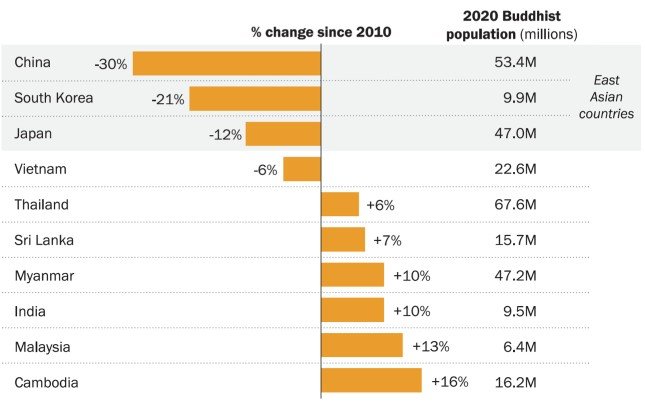
Between 2010 and 2020, the number of Buddhists in these regions fell sharply—by about 32 million. Because such a large share of the global Buddhist population lives in these countries, demographic shifts there have an outsized impact on global totals.
3. Shifts in Religious Identity
Another key factor is the movement of individuals away from Buddhism over time.
Religious identity is not always fixed; many people change their affiliation as they grow older. In the case of Buddhism, although it does attract new followers, it also loses a larger proportion of those raised within the tradition.
For every 100 people raised Buddhist:
- About 12 adopt Buddhism later in life
- Around 22 leave the religion
This results in a net loss. In other words, departures outpace conversions.
This pattern is especially visible in certain East Asian societies. In countries like Japan and South Korea, a significant share of adults no longer identify with the religion they were raised in. However, this trend is not universal—countries such as Thailand show very high levels of continuity in religious identity.
The global decline of Buddhism is not the result of a single cause, but rather a combination of demographic and social trends. An older population, fewer births, and a steady movement of individuals away from religious identification all contribute to the overall decrease.
Importantly, Buddhism continues to have a strong cultural and philosophical presence worldwide. However, unless there are shifts in population dynamics or retention rates, its share of the global population may continue to decline in the coming decades.
By Elevate Correspondent



I am hopeful the Walk For Peace brought attention to Buddhism in the United States. I, myself, newly identify as a practitioner of Buddhism. I have been attending a Temple in my area weekly for about 3 months now. I sit in Meditation three times a day. I read everything I can get my hands on! I will be forever Grateful for this new practice in my life. Sadhu Sadhu Sadhu
🌿🩷🌸🪷