Quiet Footsteps That Touched America (Part 3)
Reflections on the Journey of Buddhism in America
For me, the Walk for Peace represents more than a remarkable journey across America. It is a moment that allowed me to reflect with deep gratitude on my own life and the many years I have spent sharing Buddhism in this country.
When I first arrived in America in 1985, Buddhism was still unfamiliar to many ordinary Americans. Many people had barely heard the words “Buddhism” or “Buddhist,” and some even confused “Buddhist” with “Baptist.” Buddhist books were not commonly available in regular bookstores; those interested often had to visit specialty shops focusing on Asian cultures or Eastern traditions. When people said they knew the Buddha, they sometimes meant the image of Hotei, the Laughing Buddha, rather than the historical Buddha and his teachings.
Compared with today, the recognition and understanding of Buddhism in America were still very limited.
Over the following decades, however, many conditions came together that gradually increased awareness of Buddhism. The 1993 film Little Buddha, starring Keanu Reeves, introduced Buddhist themes to a wider international audience. Around the same period, His Holiness the Dalai Lama gained increasing recognition in America through his teachings on compassion, nonviolence, and his advocacy related to Tibet. Buddhist publications such as Tricycle Magazine were established, and books on Tibetan Buddhism, Zen, and other Buddhist traditions became increasingly available to American readers.
Today, Buddhist books can be found in many mainstream bookstores, and Buddhist ideas such as meditation, mindfulness, compassion, and interdependence have become familiar concepts to many people.
In 1993, Tricycle Magazine organized “Change Your Mind Day,” an event inviting Americans to experience meditation. I heard that approximately 300 people gathered in Central Park in New York. After moving to New York in 1994, I began attending this event. Over time, it developed into a full-day Buddhist gathering where participants brought their own mats and cushions, while Buddhist teachers guided meditation and other practices.
Gradually, Buddhism became more visible in American society. Organizations such as the New York Buddhist Council began holding Vesak celebrations commemorating the Buddha’s birth, and since 1999, Vesak observances have also been held annually at the United Nations.
After the tragedy of September 11, 2001, we organized a floating lantern ceremony on the Hudson River to remember those who lost their lives. Many New Yorkers participated in this quiet and meaningful memorial practice. Over time, this Eastern-inspired tradition became welcomed by the local community. We also continued to work together with interfaith organizations to promote understanding and harmony.
At the same time, engaged Buddhist movements addressing social issues became increasingly active, including efforts related to environmental protection, poverty, and social justice. From the perspective of mental health and well-being, meditation also gained wider attention through approaches such as Mindfulness-Based Stress Reduction (MBSR), which introduced mindfulness practices to many people beyond traditional Buddhist communities.
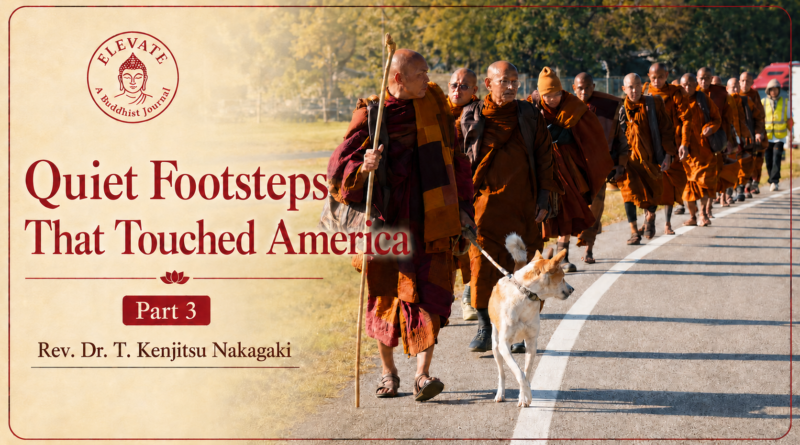
When I witnessed the Walk for Peace arriving in Washington, D.C., the entire history of Buddhism in America that I had experienced over the past four decades seemed to pass before my eyes like a revolving lantern.
I felt that the Buddhism cultivated through the dedication and compassion of countless people over many years was finally reaching those who were suffering, offering comfort, connection, and hope. I sensed that the efforts of many individuals—monks, teachers, practitioners, and supporters—were bearing fruit. This realization filled me with deep joy and gratitude.
The Walk for Peace reminded me that Buddhism is not merely an Eastern tradition belonging to one culture or one region. The teachings of the Buddha contain universal values of compassion, wisdom, mindfulness, and peace that can benefit people everywhere.
Perhaps the significance of this moment lies in the possibility that humanity is gradually moving beyond differences of culture, language, race, and religious background, and toward a deeper recognition of our shared human aspiration for peace.
I look forward with hope to the future of Buddhism in America and around the world. As a concrete practice for establishing peace in daily life, I would like to make the simple morning reflection taught by Venerable Paññākāra a part of my own daily routine:
“Today is my peaceful day.”
Perhaps peace in the world begins with this simple determination made by each person, one day at a time.
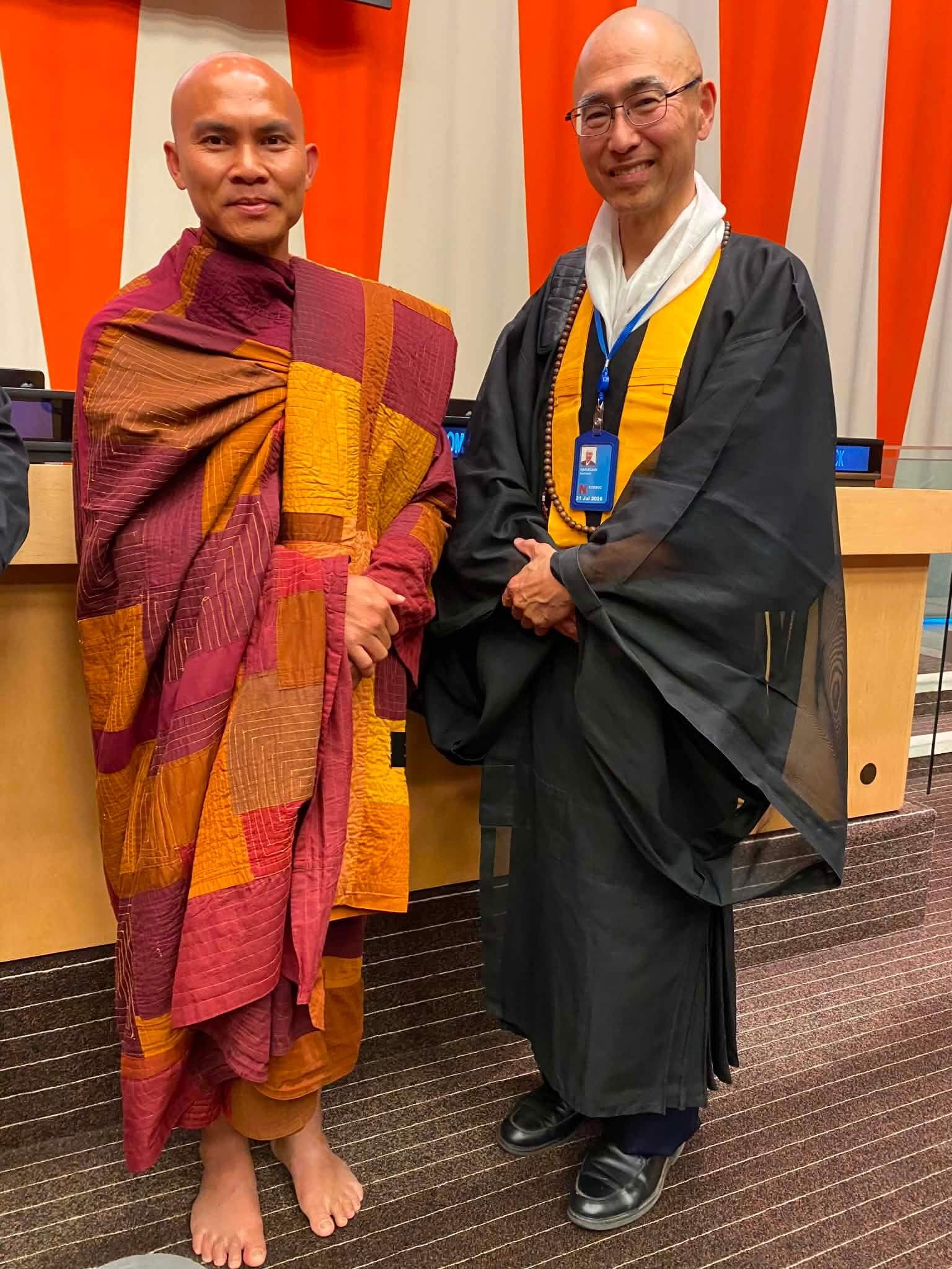
About the Author
Rev. Dr. T. Kenjitsu Nakagaki is President of the Heiwa Peace and Reconciliation Foundation of New York, Honorary President of the Buddhist Council of New York, a Hiroshima Peace Ambassador, and a Nagasaki Peace Correspondent. A graduate of Ryukoku University, he served as head priest of the New York Buddhist Temple from 1994 to 2010 and has dedicated more than four decades to Buddhist teaching, interfaith dialogue, and peacebuilding in the United States. Following the September 11 attacks, he organized Manhattan’s first 9/11 Memorial Floating Lantern Ceremony, which became an annual event for healing and remembrance. He is also the author of several books on Buddhism, peace, and intercultural understanding, including The Buddhist Swastika and Hitler’s Cross: Rescuing a Symbol of Peace from the Forces of Hate (Stone Bridge Press, 2018).
Editor’s Note
The reflections published in this three-part series were originally written by Rev. Dr. T. Kenjitsu Nakagaki for a Japanese newspaper following the conclusion of the Walk for Peace in the United States. Inspired by the public response to the pilgrimage, he later conducted an exclusive interview with Venerable Bhikkhu Paññākāra for another Japanese newspaper before the monk departed for his next Walk for Peace in Sri Lanka. With the author’s permission, Elevate: A Buddhist Journal is pleased to present these writings in English as a three-part series for our international readership.