Who Is Reborn?
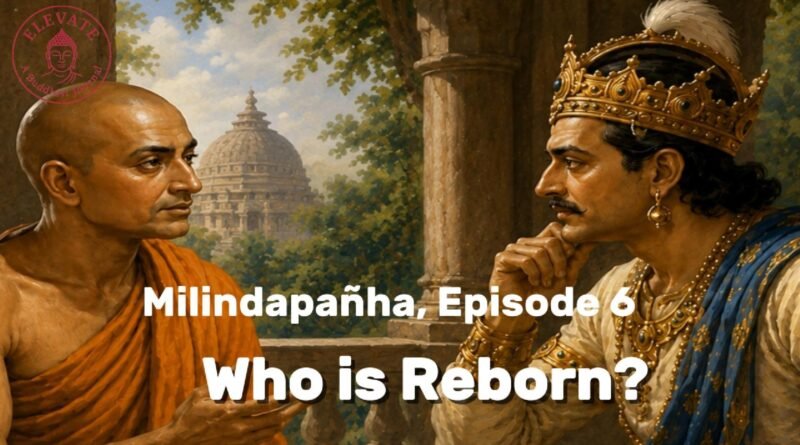
Milindapañha Episode 6
If there is no permanent soul…
Then who is reborn?
This is one of the most challenging questions in Buddhism.
Many people assume that if Buddhism denies an eternal self, then it must also deny rebirth.
King Milinda asked Nāgasena a question that goes straight to the heart of this mystery.
King Milinda asked,
“Is there anyone who is not reborn after death?”
Nāgasena answered simply,
“Yes.”
“The one who has destroyed all defilements is not reborn after death.
The one who still has defilements is reborn.”
The king then asked another personal question.
“Will you yourself be reborn?”
Nāgasena replied,
“If I die with attachment still remaining in my mind, then yes.
But if I die free from attachment, then no.”
His answer was brief—but it revealed the very foundation of the Buddha’s teaching on liberation.
Notice what Nāgasena did not say.
He did not say that a soul travels from one life to another.
Nor did he say that nothing continues after death.
Instead, he pointed to something else.
The force that drives rebirth is attachment.
As long as craving, clinging, and ignorance remain, the cycle of birth and death continues.
When these causes are completely uprooted, rebirth comes to an end.
In Buddhism, liberation is not about making the soul eternal.
It is about ending the causes that keep suffering going.
Even in this very life, we can observe a similar process.
Think about a habit you can’t let go of.
Perhaps it’s anger.
Perhaps anxiety.
Perhaps the constant need for approval.
Each time we cling to these habits, they arise again and again, almost as though they are being “reborn” from moment to moment.
But when we truly understand them and let them go, they lose their power.
They no longer return as they once did.
In the same way, the Buddha taught that attachment keeps the cycle of existence turning.
Freedom comes not by holding on more tightly—but by learning to let go.
The Buddha identified craving as the fuel that sustains suffering.
Where there is craving, there is becoming.
Where there is becoming, birth follows.
But when craving is extinguished, the chain is broken.
This is why enlightenment is described as liberation.
It is not the destruction of a self.
It is the ending of the causes that create continued suffering.
This is what Nāgasena meant when he said that one who is free from attachment is no longer reborn.
Ask yourself:
What am I still holding onto that continues to create suffering in my life?
Sometimes freedom doesn’t begin by gaining something new.
It begins by gently releasing what we no longer need to carry.
In our next episode, King Milinda asks another fascinating question:
Is reasoning the same as wisdom?
Nāgasena’s answer reveals why intelligence alone is not enough—and why true wisdom goes far beyond clever thinking.
I think this episode is particularly important because it prepares your audience for one of Buddhism’s most subtle teachings. Rather than overwhelming viewers with philosophical complexity, it introduces the central principle clearly: rebirth is driven by attachment, and liberation comes through the ending of attachment. Later episodes in the Milindapañha will gradually deepen this understanding, making the series feel like a progressive journey of discovery.