
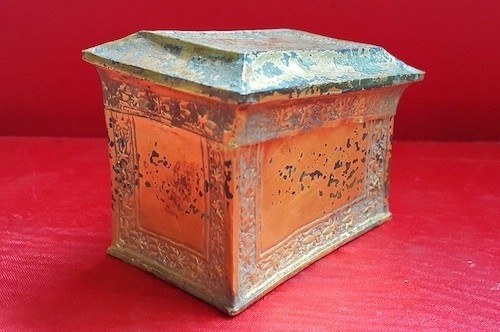
Vietnam Opens Exhibition of Nearly 1,400-Year-Old Buddha Relic Casket
NGHE AN, Vietnam — November 19, 2026 — A rare Buddhist relic casket believed to date back nearly 1,400 years has gone on public display at the Nghe An–Xo Viet Nghe Tinh Museum in central Vietnam. Thousands of people visited the museum on November 18, the first day the exhibition opened to the public. The official opening ceremony was held on November 17 evening.
The small gold casket was discovered during archaeological excavations at the Thap Nhan site in what is now Kim Lien Commune, Nghe An Province. The excavations were carried out in 1985 and 1986 by the Institute of Archaeology and the former Nghe Tinh Museum.
Archaeologists found the casket at the centre of the remains of an ancient Buddhist tower. It had been placed inside a rectangular copper container, which was kept within a hollow wooden pillar. Inside the gold casket were ash and two small, opaque white fragments, identified by archaeologists as Buddhist relics.
Measuring just 8 centimeters long, 5 centimeters wide and 5.5 centimeters high, the casket has a roof-shaped lid decorated with six-petalled floral patterns. Stylized lotus designs run around its body. Vietnam recognized it as a National Treasure in December 2017. It is described by Vietnamese sources as the only gold Buddhist relic casket of its kind discovered in the country.
The archaeological site is generally associated with the early seventh century. One important dating clue is a brick bearing the inscription ‘Trinh Quan luc nien,’ corresponding to 632 CE, during China’s Tang dynasty. The relic casket itself has been dated to the seventh or eighth century. Archaeologists have also found bricks decorated with images of Buddhas seated in meditation.
The relic’s earlier history remains uncertain. One historical interpretation connects it with the distribution of Buddha relics ordered by Sui Emperor Wen in 601 CE. Historical Buddhist records describe relics being sent to several administrative regions, including Hoan Chau, the ancient region that covered present-day Nghe An and Ha Tinh. Some Vietnamese researchers have suggested that the Thap Nhan deposit may be connected with this distribution, although the historical connection has not been established.
The exhibition, which opened on the evening of November 17, gives visitors a closer look at the casket through a specially designed display case and a transparent LED screen showing the object from different angles. A companion exhibition, “Buddhism in Nghe An through Antiquities,” presents other evidence of the region’s Buddhist history.
The relic casket offers important archaeological evidence of Buddhism in central Vietnam during the seventh century, a period for which surviving historical records from the region remain limited.
Sources:
1. VietnamPlus / Vietnam News Agency — “Nghe An puts 1,400-year-old Buddhist relic on display” (November 18, 2026).
VietnamPlus report
2. Nhân Dân — “Hộp xá lị Phật (Tháp Nhạn): Bảo vật nghìn năm của xứ Nghệ” (November 2026).
Nhân Dân historical feature
3. Nghe An Newspaper — “Thousands of people came to venerate the national treasure, the Buddha’s Relic Box (Swallow Pagoda), on its opening day” (November 18, 2026).
Nghe An Newspaper report
4. Nghe An Provincial Party Committee — “Provincial leaders visit Nhan Thap Temple relic site and inspect preparations for the National Treasure exhibition” (November 14, 2026).
Provincial report