Quiet Footsteps That Touched America
Witnessing the Walk for Peace
At a time when America was struggling with rising prices, domestic and international tensions, and deepening social divisions, a quiet yet extraordinary event took place on February 10, 2026, in Washington, D.C. Never in my life did I imagine witnessing such a day in the United States. I believe it was one of the most moving moments in the history of American Buddhism.
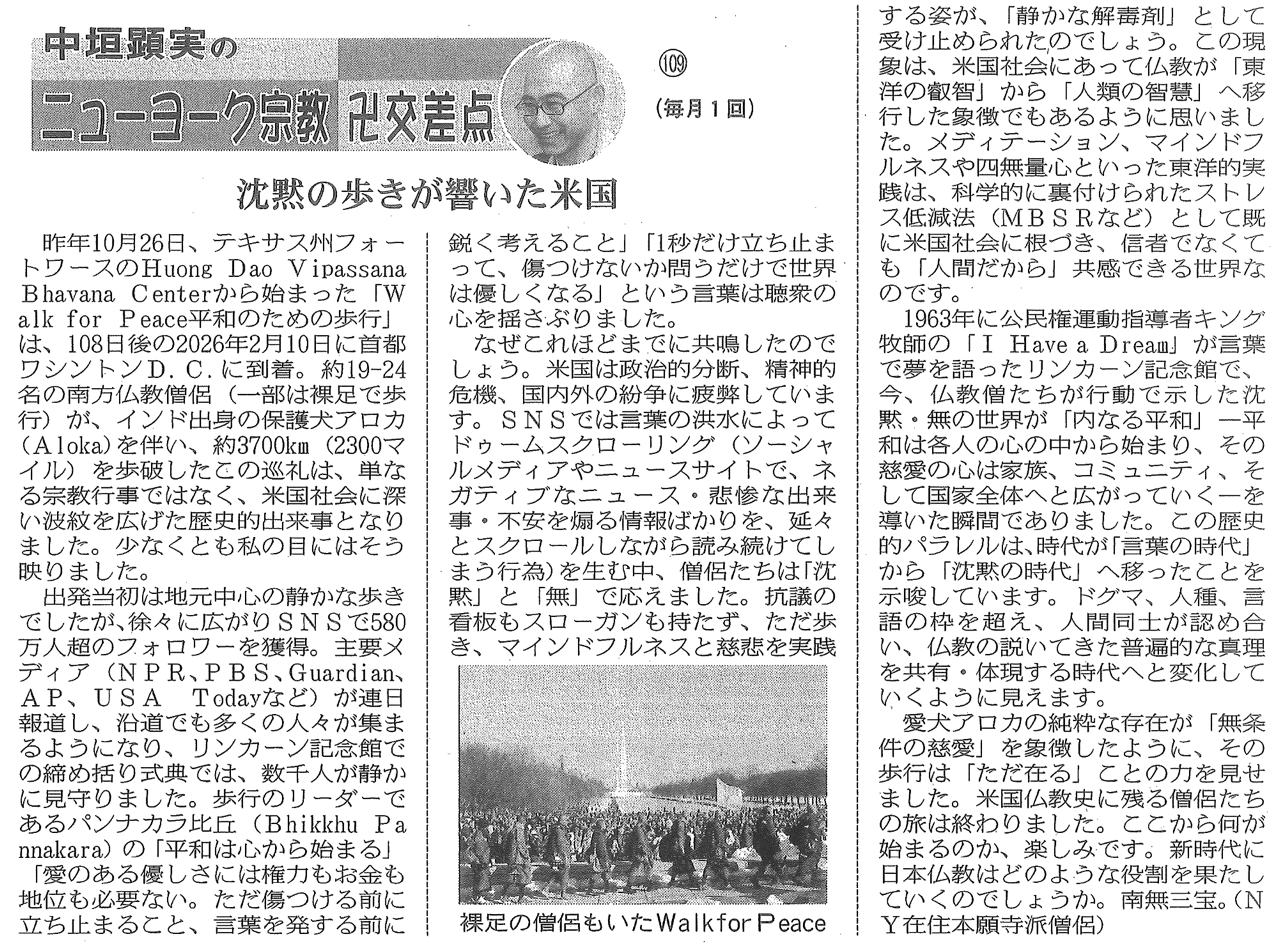
At the very place where Dr. Martin Luther King Jr. delivered his historic “I Have a Dream” speech in August 1963, a group of Buddhist monks—unknown to most Americans only months earlier—arrived at the Lincoln Memorial after walking for more than three months from Texas. Having completed their remarkable “Walk for Peace,” they stood on the snow-covered steps of the memorial and shared messages of inner peace, compassion, and healing.
Thousands of ordinary Americans gathered to welcome them with gratitude and respect. No one had organized a mass rally or called people to assemble. They came of their own accord, drawn by a shared longing for peace and compassion.
Unfortunately, I was unable to participate in the Walk for Peace in person, but I followed its progress closely through social media. Rarely has an event touched my heart so deeply or brought tears to my eyes so naturally. Several fellow monks living in New York and Toronto participated in the walk, and I spoke with them by phone on the day the group arrived in Washington.
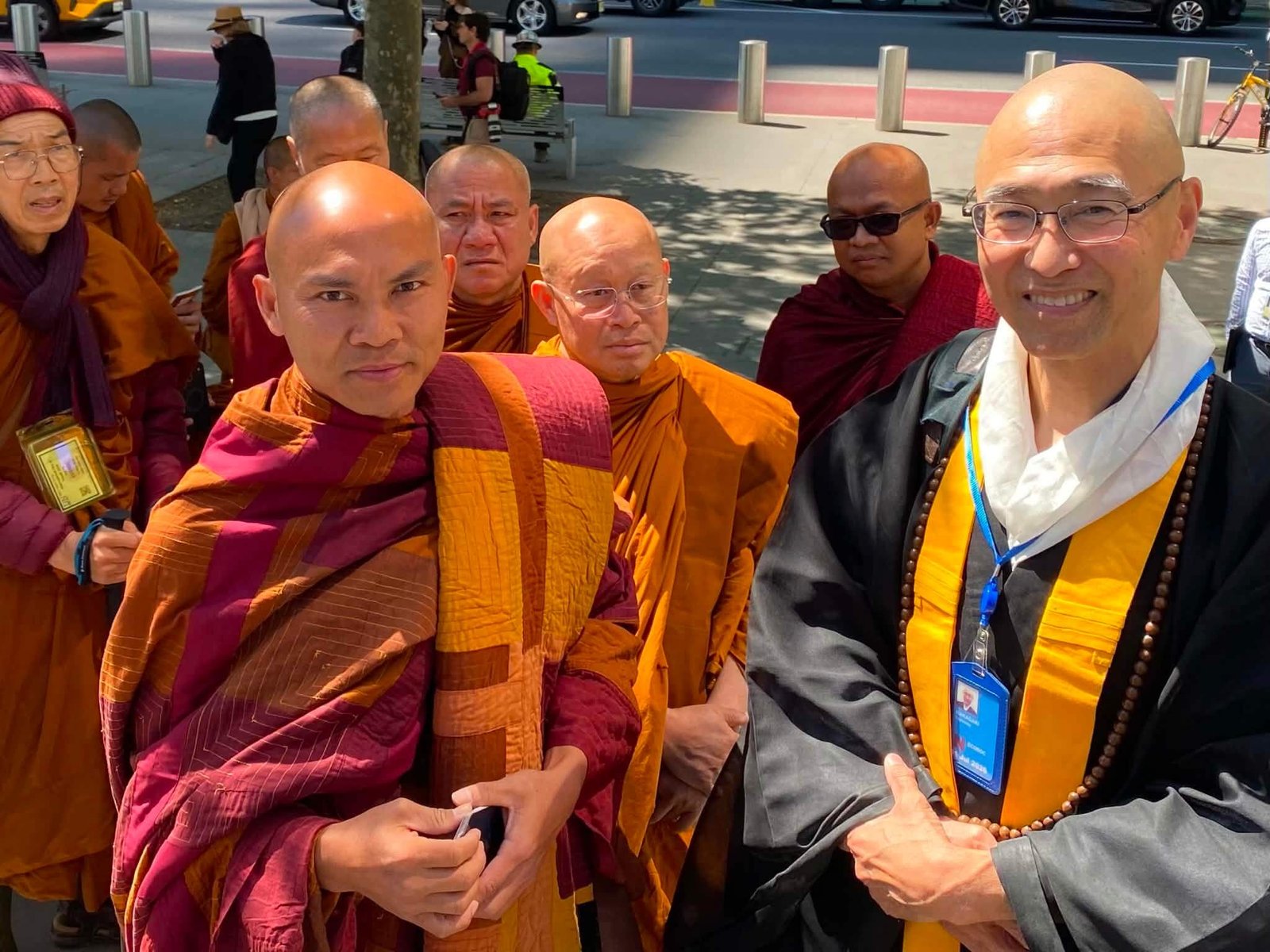
One monk told me, “We were surrounded by so many people—I have never felt so warmly welcomed before.”
Another said, “Many people were shedding tears of joy. The entire gathering was filled with compassion.”
A third reflected, “I never imagined the day would come when Buddhist teachings would resonate so deeply with so many Americans.”
Even through those conversations, I could sense the extraordinary atmosphere and peaceful energy that surrounded the gathering.
I sincerely hope that the Walk for Peace will inspire similar initiatives around the world and that the aspiration for peace will continue to grow in people’s hearts. My prayer is that this movement will encourage more people to cultivate peace in their daily lives, helping to build a society quietly rooted in compassion. In doing so, may our world gradually move away from greed, hatred, and delusion toward compassion, generosity, and loving-kindness. I believe this movement has the potential to become a great wave of positive change.
I was first assigned to North America by Nishi Hongan-ji in February 1985, and for more than forty years I have been engaged in sharing the Buddha’s teachings in the United States. During the past century, monks from many Buddhist traditions—Theravāda, Mahāyāna, and Vajrayāna—and from numerous Buddhist countries, including Japan, have come to America and devoted themselves to serving their communities. Looking back, I feel that the Walk for Peace represents the fruition of those decades of quiet and dedicated effort.
Many people have devoted their lives to sowing the seeds of the Dharma and nurturing the conditions for Buddhism to flourish on American soil. To my eyes, those seeds have finally begun to sprout. Having endured the cold of winter, they now seem to be blossoming all at once in the warmth of spring. It feels as though the right time has finally arrived.
As I write these words in April 2026, hundreds of bright yellow dandelions are blooming throughout my garden in suburban New York. Although their abundance may suggest that my garden is not perfectly maintained, I cannot bring myself to pull them out. They bloom so earnestly, and each year they return in even greater numbers. Together they create a beautiful scene, radiating resilience and the vitality of life. In much the same way, I believe the seeds of peace will continue to grow with quiet strength.
When I first arrived in the United States, I dreamed that Buddhism would one day be more widely understood here—that the Dharma would nourish people’s hearts, bring them peace and happiness, and perhaps even help transform society. As the years passed, I gradually began to wonder whether I would live to see that dream fulfilled.
Then came the Walk for Peace.
In many ways, it transformed what had become a fading hope into a living reality.
Somewhere deep within me, I may even have begun to think that America was beyond hope. If so, this walk changed not only my view of the country’s future, but also my own. It renewed my confidence in human potential, in what Buddhism calls Buddha-nature, and in the transformative power of the Dharma. Above all, it encouraged me to continue moving forward with hope.
My Encounter with the Walk for Peace
I first learned about the Walk for Peace after hearing news, on November 20 of last year, that a Buddhist monk had been seriously injured in a traffic accident near Dayton, Texas. Until then, I knew nothing about the pilgrimage. Seeing reports of Buddhist monks involved in such an accident in a place where one would hardly expect to encounter them naturally aroused my curiosity, and I began following their journey.
According to reports, a truck driver failed to notice the line of monks walking along the roadside and struck them. Two monks were hospitalized, and one of them tragically lost a leg as a result of the accident. Despite this heartbreaking setback, the monks remained determined to complete their pilgrimage. Without abandoning their original plan, they continued their journey toward Washington, D.C. From that point on, I followed their progress through social media whenever I could.
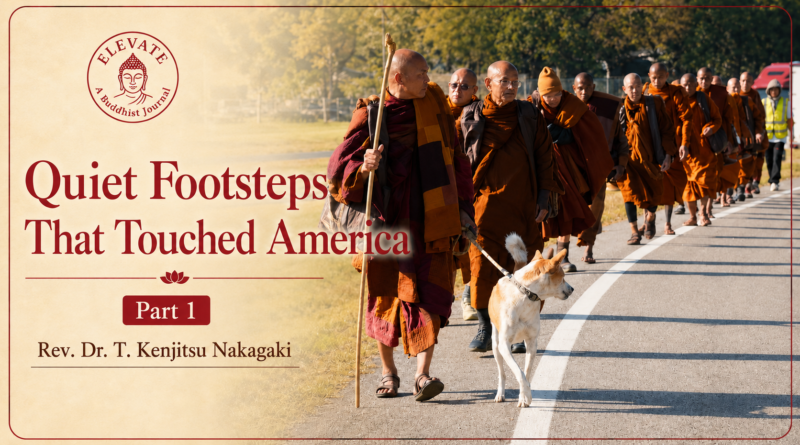
As I learned more about the pilgrimage, I discovered that the Walk for Peace had begun on October 26, 2025, at the Huong Dao Vipassana Bhavana Center in Fort Worth, Texas. A group of twenty-five Buddhist monks from Thailand, Laos, Myanmar, and Vietnam, accompanied by Aloka—a rescued dog from Kolkata, India—set out on foot for Washington, D.C.
The walk was led by Venerable Bhikkhu Paññākāra. Throughout the journey, the monks observed the traditional discipline of the Buddhist monastic life. They walked mindfully from community to community, accepted alms offered by lay supporters, chanted suttas, shared the Buddha’s teachings, and encouraged people to cultivate mindfulness, compassion, harmony, inner peace, and healing.
From the warmth of autumn to the bitter cold of winter, they walked approximately 3,700 kilometers (2,300 miles) across eight states before finally arriving in Washington, D.C., on February 10, 2026.
At first, the Walk for Peace was a quiet, community-based pilgrimage that attracted little public attention. Gradually, however, its message began reaching wider audiences through social media. As interest grew, major news organizations—including NPR, PBS, the Associated Press, and USA Today—began reporting on the journey.
By January, organizers reported that approximately 20,000 people had gathered to welcome the monks in Columbia, South Carolina. As the group moved closer to Washington, D.C., even larger crowds lined the roads to greet them. According to the organizers, the Walk for Peace’s Facebook following eventually exceeded 2.5 million people, while its combined social media reach surpassed 5.8 million. Videos documenting the pilgrimage were reportedly viewed more than 100 million times.
For many people in Japan who followed the pilgrimage online, the scenes unfolding across America seemed almost unbelievable. They watched as Americans stood along roadsides offering flowers to monks in saffron robes. Others greeted them with palms joined in reverence, while some chose to walk beside the monks for part of their journey. Still others sat quietly in meditation as the procession passed.
Even through social media, one could sense the warmth and sincerity of these encounters. There were no angry voices or heated confrontations. Instead, there were gentle conversations, thoughtful questions from members of the public, and calm, compassionate responses from the monks. The atmosphere itself seemed to embody the very message the pilgrimage sought to convey.
Aloka, the rescued dog, also became a beloved companion throughout the journey and appeared frequently in social media posts. In January, an old injury from his days as a stray in India worsened, requiring surgery on one of his legs. Remarkably, only ten days after the operation, he rejoined the pilgrimage and continued walking with the monks until they reached Washington.
Many people found comfort simply in Aloka’s presence. To me, he came to symbolize unconditional love, quiet resilience, and companionship. His journey reminded us that compassion extends beyond human beings alone. Throughout the pilgrimage, people and animals shared the same road, the same hardships, and the same aspiration for peace.
The Arrival at the Lincoln Memorial
In this way, the monks finally arrived in Washington, D.C., and the historic event at the Lincoln Memorial, which I described at the beginning of this article, took place.
Their message was simple yet profound:
“We are not uniting to fight against something. We are coming together for something positive—for peace of mind.”
They also said:
“This is not a protest. It is about letting go of hatred and continuing to seek peace within ourselves.”
These words expressed the very spirit of the Walk for Peace.
Standing at the Lincoln Memorial, the monks gathered at the same site where Dr. Martin Luther King Jr. delivered his famous “I Have a Dream” speech in August 1963. For me, this carried deep symbolic meaning.
Dr. King’s speech called upon America to pursue justice, equality, and racial harmony through the power of nonviolence. More than sixty years later, another peaceful gathering took place at the same historic location. While the historical contexts were different, I found it deeply moving that the monks presented another path toward peace—one that began with inner transformation.
Rather than raising their voices, they demonstrated the practice of inner peace through silence, mindfulness, and compassionate action. Their journey itself became their message. Through their quiet presence, they conveyed a Buddhist vision of peace that reaches beyond words.
Watching this unfold, I felt that many Americans responded not simply to the monks themselves, but to the values they embodied. In a society often marked by tension and division, their message of mindfulness, compassion, healing, and nonviolence touched the hearts of many people.
To me, the Walk for Peace suggested that America may be entering a period in which these Buddhist values are being received with increasing openness. Whether or not this proves to be a lasting change, I found the response to the pilgrimage deeply encouraging.
For more than a century, Buddhist monks and teachers from many traditions—Theravāda, Mahāyāna, and Vajrayāna—and from many countries have devoted themselves to sharing the Dharma throughout the United States. Looking back, I cannot help but feel that the Walk for Peace reflects the cumulative efforts of those who patiently planted seeds over many decades.
From a Buddhist perspective, no event arises from a single cause. Every result depends upon many conditions coming together. In that sense, I believe this pilgrimage did not happen by chance. Rather, it represents the natural flowering of countless acts of dedication, faith, and compassionate service carried out by generations of practitioners.
As I reflect on that bone-chilling day at the Lincoln Memorial, what remains most vivid in my mind is not simply the size of the gathering, but its atmosphere.
People from different backgrounds stood together peacefully.
Many welcomed the monks with flowers.
Some joined their palms in respect.
Others quietly walked beside them or sat in meditation.
There was no hostility, no confrontation—only a shared aspiration for peace.
That is the memory that continues to stay with me.
For this reason, I believe the Walk for Peace will remain a significant milestone in the history of Buddhism in America. More importantly, I hope it will inspire people everywhere to recognize that lasting peace begins not only in society, but within each individual heart.
About the Author
Rev. Dr. T. Kenjitsu Nakagaki is President of the Heiwa Peace and Reconciliation Foundation of New York, Honorary President of the Buddhist Council of New York, a Hiroshima Peace Ambassador, and a Nagasaki Peace Correspondent. A graduate of Ryukoku University, he served as head priest of the New York Buddhist Temple from 1994 to 2010 and has dedicated more than four decades to Buddhist teaching, interfaith dialogue, and peacebuilding in the United States. Following the September 11 attacks, he organized Manhattan’s first 9/11 Memorial Floating Lantern Ceremony, which became an annual event for healing and remembrance. He is also the author of several books on Buddhism, peace, and intercultural understanding, including The Buddhist Swastika and Hitler’s Cross: Rescuing a Symbol of Peace from the Forces of Hate (Stone Bridge Press, 2018).
Editor’s Note
The reflections published in this three-part series were originally written by Rev. Dr. T. Kenjitsu Nakagaki for a Japanese newspaper following the conclusion of the Walk for Peace in the United States. Inspired by the public response to the pilgrimage, he later conducted an exclusive interview with Venerable Bhikkhu Paññākāra for another Japanese newspaper before the monk departed for his next Walk for Peace in Sri Lanka. With the author’s permission, Elevate: A Buddhist Journal is pleased to present these writings in English as a three-part series for our international readership.