Quiet Footsteps That Touched America (Part 2)
Peace Begins Within: An Interview with Venerable Bhikkhu Paññākāra
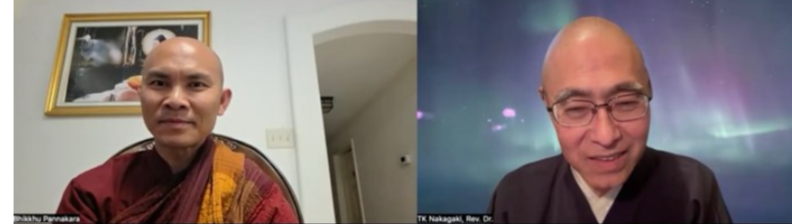
After receiving the request to write this article, I wondered whether I would have an opportunity to speak directly with Venerable Paññākāra. Then, by chance, a group of Bangladeshi Buddhists in New York contacted me for consultation, and we arranged a meeting.
A monk named Bhikkhu Visuddha, who was present at the meeting, had previously stayed at the same temple in Texas as Venerable Paññākāra. He asked for my help in inviting Venerable Paññākāra to New York. Although I was unsure whether the timing would work for this article, I reached out to him. Fortunately, before departing for Sri Lanka for his next Walk for Peace, he was able to make time for an interview.
We were able to conduct a Zoom interview on April 13. The following is the content of that conversation.
Nakagaki Kenjitsu (hereafter Nakagaki): Why did you decide to undertake this Walk for Peace?
Venerable Paññākāra (hereafter Paññākāra):
I have lived in Fort Worth for more than 30 years since my ordination. During those years, I have witnessed a great deal of suffering around me, especially mental suffering.
Through my missionary work and disaster relief activities, I encountered many people who were suffering. Time and again, I reflected on these experiences and kept asking myself, “As a Buddhist monk, what can I do?”
If I remain at this monastery, we can only serve a limited number of people. But what about the people outside the temple?
That question eventually led me to the idea of walking from Texas to the nation’s capital, Washington, D.C.
In modern America, many people are interested in meditation and mindfulness through YouTube, Facebook, and other platforms. However, I felt there was a significant gap. Learning about mindfulness as information and actually practicing it are completely different things.
True practice requires guidance from a teacher who can lead people step by step. As monks, we understand this very well.
I could not think of a better way than a walk to share this message—to let people know that peace is always present within them. All they need to do is slow down or pause for a moment. When they turn inward and reflect, they can discover that peace is already there.
Because people continue chasing material possessions and seeking fulfillment in the outside world, they often lose touch with their inner peace.
Nakagaki: I understand your intention to create connections between the Dharma and more Americans. When did you come up with this plan? Was this your first project? Why did you choose Washington, D.C. as the destination at this particular time?
Paññākāra:
We began planning around the summer, approximately four months before the walk began. Then we decided on the route and made preparations, such as arranging support vehicles and other necessary arrangements.
This was my first peace walk in America, but I had previously walked for 112 days in India.
Washington, D.C. is the nation’s capital. In order to share the message of peace with as many people as possible, I thought the destination should be near the White House area. I felt that this would be the best place to spread our message more broadly.
Nakagaki: You planned this carefully in a relatively short period of time while remaining true to your original intention.
Paññākāra:
I am very grateful that we received so much support.
Before the walk began, our resources and volunteers were limited. We did not have enough volunteers in the beginning. However, as we continued our journey, more and more people came forward to help us. Eventually, many volunteers joined us.
That was a great surprise and a great blessing.
Many people have asked, “Why now? Why during winter?”
I actually developed the idea of the Walk for Peace during the summer and received permission from my teacher to undertake this journey. We chose the timing through a process of elimination because we needed a period when we could walk continuously for three months.
From June to September is the rainy season retreat (Vassa). October is difficult because of the Kathina robe-offering ceremonies after the retreat. From May, there are Vesak celebrations and the Tipiṭaka chanting ceremony involving Buddha relics from Sri Lanka.
Therefore, after considering all these factors, the only available period was the winter season, from November to February.
Nakagaki: Did you anticipate the response from Americans when you began the walk?
Paññākāra:
I was overwhelmed by the unexpected number of people who came to welcome us.
Everywhere we went, people were waiting for us. Along the roads, during lunch breaks, and even when we stopped for the night, many people came to meet us.
Rain or snow, freezing temperatures or difficult conditions—regardless of the weather, people were there. They waited for us for hours with great patience.
I was truly touched by their kindness.
Nakagaki: Did you anticipate the response from Americans when you began the walk?
Paññākāra:
I was overwhelmed by the unexpected number of people who came to welcome us.
Everywhere we went, there were people waiting for us. Every day, along the roads, during lunch breaks, and later when we stopped for the night, many people came to meet us.
Rain or snow, freezing cold or difficult weather conditions—regardless of the circumstances, people were there. They waited for us for hours with great patience.
I was truly touched by their kindness.
Many people cried and told us that their tears were tears of joy. Many people said to us, “You changed my life.”
We monks were simply walking, but it seems that our presence gave hope and support to many people. Some people told us, “You saved my life.” Some shared that the Walk helped them during moments when they were struggling deeply, including thoughts of giving up.
I am grateful that we were able to do something meaningful for our nation and for our people.
People from many different countries followed our journey. Videos and talks from the Walk have been translated into many languages. I hope this becomes an opportunity for more people to discover inner peace and begin practicing mindfulness.
Nakagaki: The dog Aloka also became very popular during the Walk for Peace.
Paññākāra:
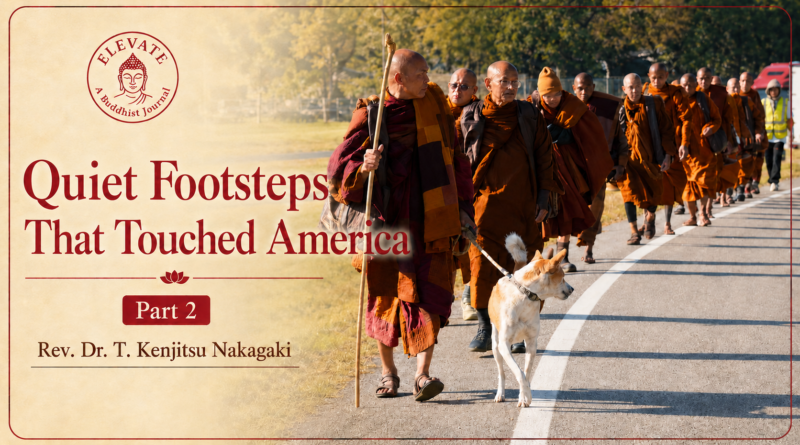
This pilgrimage touched many people’s hearts. Aloka became very popular, and we are preparing to take him to Sri Lanka soon.
Recently, he has received so much love and attention that he has become a little spoiled, so we need to train him again as we did before. His health is good, and he is energetic.
People love animals. It is very rare to find a dog walking for peace, so Aloka’s presence is precious and unique. He has now become a “Peace Dog Ambassador.”
He has received many dog badges from sheriffs and police departments. Animal welfare organizations from many countries are also requesting his help and support. Aloka now has his own mission.
Nakagaki: While walking, did you have any particular thoughts or reflections?
Paññākāra:
While walking, I sometimes thought about the Buddha. I felt deep respect and gratitude toward him.
Because of the Buddha’s teachings, I am able to do something to support the Buddha Sāsana and continue carrying his teachings forward.
The Buddha instructed his disciples not to remain together in one place, but to go to different places to spread the teachings for the benefit of all beings—humans and devas.
Everything we have today is because of the Buddha.
Nakagaki: Finally, could you share a message for Japanese readers?
Paññākāra:
I would like to share a message that I always share wherever I go and every day. It is very simple, but it is very powerful for me.
Every morning when we wake up, while our minds are still fresh and clear, please take a positive action.
If we do not give our minds a wholesome direction, they will continue producing “garbage”—scattered thoughts, unpleasant emotions, and suffering.
Before our minds begin collecting those things, make your bed. Do not touch your phone. Go to the bathroom. Then take a piece of paper and a pen and write:
“Today is my peaceful day.”
Read it aloud. Confirm it with your eyes. Let it become firmly established in your memory.
Even if you already know the words, continue reading them again and again. This is how we begin a new day with intention.
Otherwise, our day can easily become disturbed and distracted.
After that, read the words aloud and tell the universe:
“Today is going to be my peaceful day.”
Make a strong determination within yourself that no one can take that peace away from you—except yourself.
Then remain mindful throughout the day. Be mindful of everything you do, and do one thing at a time.
That is how we practice mindfulness.
This is the message that I hope everyone in the world can practice every single day when we open our eyes in the morning.
For a long time, humanity has been spreading hatred, anger, and negativity into the world. This is the time to stop that and instead spread messages of peace throughout our communities and throughout the world.
When we send peace into the world, it will return to us. As people often say, “What goes around comes around.”
I believe that if we continue cultivating peace within ourselves and sharing it with others, we will definitely create a better world in which everyone can live.
Nakagaki: Thank you very much for taking the time to speak with me, especially while you are preparing to leave for Sri Lanka the day after tomorrow. I pray for the success of your next Walk for Peace in Sri Lanka. I also hope that you will have an opportunity to visit Japan in the near future.
Paññākāra:
I definitely want to visit Japan. Before that, I look forward to seeing you in Toronto in May.
Thank you very much for today.
About the Author
Rev. Dr. T. Kenjitsu Nakagaki is President of the Heiwa Peace and Reconciliation Foundation of New York, Honorary President of the Buddhist Council of New York, a Hiroshima Peace Ambassador, and a Nagasaki Peace Correspondent. A graduate of Ryukoku University, he served as head priest of the New York Buddhist Temple from 1994 to 2010 and has dedicated more than four decades to Buddhist teaching, interfaith dialogue, and peacebuilding in the United States. Following the September 11 attacks, he organized Manhattan’s first 9/11 Memorial Floating Lantern Ceremony, which became an annual event for healing and remembrance. He is also the author of several books on Buddhism, peace, and intercultural understanding, including The Buddhist Swastika and Hitler’s Cross: Rescuing a Symbol of Peace from the Forces of Hate (Stone Bridge Press, 2018).
Editor’s Note
The reflections published in this three-part series were originally written by Rev. Dr. T. Kenjitsu Nakagaki for a Japanese newspaper following the conclusion of the Walk for Peace in the United States. Inspired by the public response to the pilgrimage, he later conducted an exclusive interview with Venerable Bhikkhu Paññākāra for another Japanese newspaper before the monk departed for his next Walk for Peace in Sri Lanka. With the author’s permission, Elevate: A Buddhist Journal is pleased to present these writings in English as a three-part series for our international readership.