
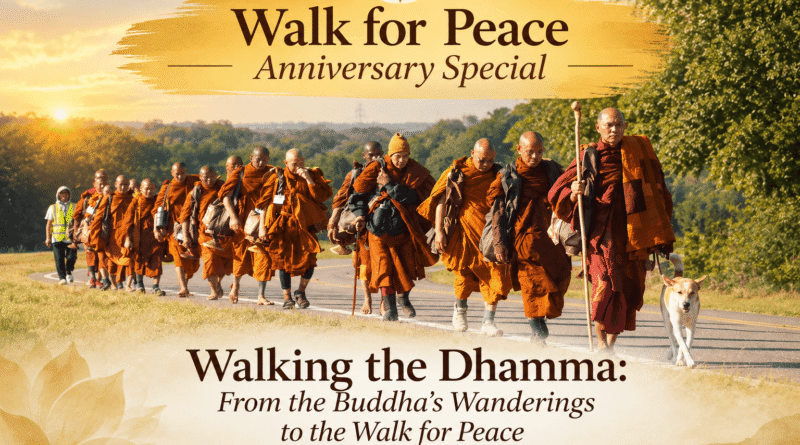
Walking the Dhamma: From the Buddha’s Wanderings to the Walk for Peace
Dr. Neeraj Bajracharya
Abstract
The Buddhist tradition has long associated the Dhamma with movement: the Buddha and his disciples wandered from place to place, teaching and engaging with communities. This article explores that tradition through the lens of the 2025–2026 Walk for Peace, during which Buddhist monks traveled more than 2,300 miles on foot from Fort Worth, Texas, to Washington, D.C. It examines the relationship between Buddhist wandering, walking as practice, monastic simplicity, dhutaṅga, the Thai thudong tradition, and the historical concept of Dhamma-yātrā. Drawing on Buddhist texts and firsthand experience as a coordinator of the Walk for Peace, the article considers how an ancient tradition encountered the religious, cultural, and historical landscape of contemporary America. Experiences along the journey, particularly in Jackson, Selma, and Montgomery, illustrate how peace, compassion, unity, and healing became participatory rather than merely proclaimed. Ultimately, the journey invites a deeper question: not simply how far we walk, but how we walk—with what kind of mind, heart, and intention.
Keywords: Buddhist Wandering; Dhutaṅga; Thudong; Dhamma-yātrā; Monastic Practice; Walking Meditation; Buddhist Pilgrimage; Walk for Peace
On October 26, 2025, a group of Buddhist monks led by Venerable Bhikkhu Paññākāra left Fort Worth, Texas, on foot, beginning a journey that would eventually take them more than 2,300 miles to Washington, D.C. They walked through changing landscapes, weather, cities, towns, and communities, carrying little with them and relying on the generosity of people they encountered along the way. Their stated purpose was simple yet ambitious: to walk for peace, compassion, unity, and healing.
I was involved with the Walk for Peace from its early planning stages and served as its events coordinator, government liaison, and press coordinator. As part of my job, I have spoken to many TV and news outlets. I have written elsewhere about how I became involved and what happened during those early days of planning. Here, I want to step back from that personal story and ask a broader question: What does it mean, in the Buddhist tradition, for monks to walk thousands of miles carrying a message of peace?
As someone who was closely involved in the Walk for Peace from its early planning stages, my perspective in this article is that of a participant and firsthand observer rather than an outside scholar. I draw on that experience, together with Buddhist textual sources and relevant scholarship, to explore how this contemporary journey resonates with older Buddhist traditions of wandering, simplicity, and Dhamma-related travel.
Ven. Anil Sakya has interpreted contemporary walking for peace as a form of “embodied compassion,” emphasizing the convergence of contemplative discipline and outward social responsibility (Sakya 2026). Building on this perspective, while approaching the subject from a historical and experiential angle, the present study asks a different but related question: how does the contemporary Walk for Peace relate to older Buddhist traditions of wandering, ascetic discipline, and Dhamma-related travel?
A Tradition Born on the Road
The Buddha was not a teacher who remained in one place. Soon after his awakening, he sent forth the first sixty arahants with a simple instruction:
“Caratha, bhikkhave, cārikaṃ bahujanahitāya bahujanasukhāya lokānukampāya atthāya hitāya sukhāya devamanussānaṃ…”
“Walk, monks, for the good of the many, for the happiness of the many, out of compassion for the world, for the benefit, welfare, and happiness of gods and humans.”
Recorded in the Vinaya Piṭaka (Mahāvagga I.11.1), this instruction captures something fundamental about the early Buddhist mission: the Dhamma was meant to move outward.
The Buddha and his disciples traveled from community to community, teaching, receiving alms, meeting people, and making the path available to others. The road was not merely a means of getting from one place to another; it became one of the ways in which the Dhamma was lived and shared.
The early Saṅgha was similarly mobile. Monks wandered from place to place, depending on alms and seeking suitable conditions for practice and teaching. The establishment of the rains residence eventually created a period when monks remained in one location, but outside that period, wandering was an ordinary part of monastic life.
This history gives Buddhist walking a context that is easy to overlook. Walking was not simply transportation. It was part of the life of renunciation, teaching, dependence on others, and encounter with the world.
When Walking Becomes Practice
The early texts also distinguish between merely traveling and traveling with purpose.
In the Dīghacārika Sutta (AN 5.221), the Buddha discusses the value of purposeful wandering and the limitations of aimless travel. Wandering can expose a person to new learning, deepen understanding, build confidence, and create opportunities to develop relationships.
The Caṅkama Sutta (AN 5.29), meanwhile, describes five benefits of walking meditation: developing endurance for travel, enduring exertion, maintaining health, digesting food well, and strengthening concentration.
Neither text presents a long-distance peace walk in the modern sense. Yet together they show that movement could have a meaningful place within Buddhist practice when undertaken with intention.
The distinction matters. The Buddhist tradition does not make distance itself sacred. It asks what happens to the mind while one is traveling. That question becomes particularly important when we consider the ascetic practices known as dhutaṅga.
Simplicity as a Form of Training
The early Buddhist ideal of monastic life involved radical simplicity. In the Sāmaññaphala Sutta (DN 2), the Buddha describes robes, almsfood, and basic shelter as the contentment of a monk, much like a bird that carries only its wings.
This spirit later became closely associated in Theravāda tradition with dhutaṅga—ascetic practices intended to cultivate fewness of wants, contentment, renunciation, energy, and seclusion.
Traditionally, there are thirteen dhutaṅga practices. They include such disciplines as wearing refuse-rag robes, using only three robes, accepting almsfood, eating from one bowl, eating only one meal a day, dwelling in the forest, dwelling at the root of a tree, living in the open air, and dwelling in a cemetery.
A doctrinal point is important here: walking itself is not one of the thirteen dhutaṅgas, nor is walking barefoot. The formal thirteenfold classification is preserved in later Theravāda literature, including the Milindapañha and the Visuddhimagga, while the individual practices have earlier Buddhist precedents in the Nikāyas and Vinaya.
This distinction helps us understand the Walk for Peace more accurately. The journey was described on several occasions by its organizers as a “Dhutaṅga Journey,” and several practices associated with the ascetic tradition were deliberately incorporated into it. Some monks observed one meal a day; some walked barefoot; some slept beneath trees; and the journey required extraordinary simplicity and dependence on the generosity of others.
But the walk itself should not be confused with the technical definition of dhutaṅga.
Dhutaṅga Is Not Suffering for Suffering’s Sake
Why would a Buddhist deliberately choose practices that make life harder?
The answer is not that suffering is inherently purifying. Buddhist practice is not an exercise in collecting hardship as an achievement.
The value of an ascetic practice lies in what it reveals and trains in the mind.
When food is limited, comfort becomes less available, or the body becomes tired, attachment and aversion can become more visible. One begins to see impatience, craving, pride, fear, or resistance that might remain hidden under comfortable circumstances.
The hardship is therefore a condition for practice, not the goal of practice.
This perspective helped me understand the Walk for Peace differently. The long distances, physical exhaustion, weather, blisters, uncertainty, and dependence on others were not simply obstacles standing between the monks and Washington, D.C. They became part of the environment in which patience, discipline, humility, compassion, and perseverance could be practiced.
The distance traveled has never been the measure of the journey. The real measure is what happens to the mind along the way.
From Dhutaṅga to Thudong
There is another important connection, particularly because several monks participating in the Walk for Peace came from traditions in which wandering and forest practices remain living traditions.
In Thailand, the term thudong—derived from dhutaṅga—has come to refer more broadly to a wandering, ascetic, forest-oriented, and meditative way of life. It is related to the thirteen ascetic practices but should not simply be equated with them.
In traditional Thai Buddhist contexts, thudong monks might leave monasteries and travel on foot, sometimes spending extended periods in forests or other secluded places. Pilgrimage and wandering could become part of this way of life.
This broader meaning helps explain why the image of monks walking long distances still has such resonance in parts of the Buddhist world. The practice is not merely a historical reconstruction. In some traditions, the wandering life has continued, adapted, and remained part of living Buddhist practice.
The Walk for Peace brought this old image into an entirely different environment: American highways, city streets, state capitols, interfaith gatherings, and communities unfamiliar with Buddhist monastic life.
From Wandering to the Dhamma-yātrā
Buddhist traditions of meaningful travel also developed in other forms.
Centuries after the Buddha, Emperor Aśoka used the term Dhamma-yātrā for journeys undertaken in connection with Dhamma. In Major Rock Edict VIII, Aśoka contrasts such journeys with earlier royal pleasure tours and describes visits to ascetics and elders, charitable activity, and conversations about Dhamma. The edict also associates an early Dhamma journey with a visit to Sambodhi, traditionally identified with Bodh Gaya.
Dhutaṅga, thudong, Dhamma-yātrā, and pilgrimage are therefore related but distinct ideas. They should not be treated as stages of one simple historical progression.
Dhutaṅga concerns ascetic discipline. Thudong can describe a broader wandering and forest-oriented way of life. Dhamma-yātrā describes a journey undertaken in connection with Dhamma, while pilgrimage generally involves travel toward a sacred place.
The Walk for Peace brought elements of several of these traditions together in a distinctly modern form.
What Made the Walk for Peace Different?
The monks who walked across America were not simply repeating an ancient practice. They were walking through a very different world.
They crossed highways and city streets rather than ancient Indian paths. They moved through communities shaped by many religions, cultures, ethnicities, and political perspectives. They met people who had never encountered Buddhist monks before. And they walked explicitly for peace.
Along the route, people offered food and shelter, walked alongside the monks, attended gatherings, welcomed them at state capitols, or simply stood by the roadside. Buddhists were joined by Christians, Hindus, Muslims, people of other faiths, and people with no particular religious affiliation.
I saw this especially clearly in Columbia, South Carolina, where local partners organized an interfaith gathering and people from different religious traditions and government institutions came together. After the meal, people joined the monks for the walk to the State Capitol. Events such as “Join the Walk” to the State Capitol made the Walk open to everyone, giving people an opportunity to participate rather than simply watch.
The journey also reached far beyond those who physically walked with the monks. Images and stories traveled through social media and news coverage around the world. A meal, a place to sleep, a few miles walked alongside the monks, a welcome at a gathering, or a message shared from thousands of miles away could become an expression of the same aspiration.
The monks carried the message across the miles; communities across America carried it forward; and people around the world carried it beyond America.
What I Learned as a Coordinator
Being involved in the coordination of such a journey gave me a different perspective on what it means to walk for peace.
The ancient tradition met the realities of modern life: routes had to be planned, schedules adjusted, communities coordinated, government officials contacted, media questions answered, lodging arranged, and unexpected problems addressed. It was not always peaceful behind the scenes.
One of the most difficult moments came when one of the monks suffered a life-changing injury and ultimately lost his leg. At that point, the journey became less about schedules or distances and more about caring for a person and supporting one another through circumstances nobody had anticipated.
That experience reminded me that compassion is tested most seriously when circumstances become difficult.
Another important moment came in Jackson, Mississippi, where we experienced one of the first major state-capitol gatherings of the journey. The gathering came together largely through the efforts of local volunteers, including two women whose backgrounds were quite different—one Vietnamese American and the other a White American meditation practitioner. They worked with remarkable dedication to welcome the monks at the State Capitol and bring the local community together. The successful peace gathering at the State Capitol gave our team a much needed confidence. The Walk for Peace was beginning to belong not only to those who had planned it, but also to the communities that encountered it.
Alabama brought an even deeper dimension.
When the venerable monks walked across the Edmund Pettus Bridge in Selma, it was a moment that felt almost surreal—not only because of the history of the place, but because of the way people responded to their presence. Selma and Montgomery carry memories of profound suffering and struggle, but they are also places deeply connected to the continuing search for healing.
Standing there, we began to understand that the communities we were passing through were themselves on journeys of healing. The presence of the monks therefore carried a meaning that went beyond the Walk for Peace itself.
When the monks offered prayers and chanting on the bridge, the atmosphere changed. Emotion was visible among those who had gathered. For me, it was one of the clearest moments when the fourth pillar of the Walk for Peace—healing—became something tangible rather than simply a word in our mission statement.
We decided to stay overnight in Montgomery so that we could spend more time with local residents and communities. The decision was itself a reminder that a journey like this cannot always be governed by a fixed itinerary. Sometimes the road asks us to slow down and listen.
The following day, we invited people to “Join the Walk” event, accompanying the monks from Montgomery’s historic Train Shed to the State Capitol, with stops at significant sites along the way, including the National Memorial for Peace and Justice, where prayers and chanting were offered for healing.
Thousands of people from different communities joined the walk. Watching people of different faiths come together in prayer and chanting made the meaning of the journey tangible.
Peace was no longer simply a message being carried by the monks. It was something people were participating in together.
These experiences also showed me how much of a peace journey happens away from the public eye. Coordination involves constant communication, adjustment, patience, and sometimes disagreement. As press coordinator, I also learned that communicating the journey was itself a responsibility: words could either help people understand the deeper purpose of the walk or reduce it to a spectacle of endurance.
The road tested more than the monks’ feet. It tested our intentions, our patience, and our ability to live the values we were describing.
What Are We Carrying, and How Are We Walking?
A traditional Buddhist monk may deliberately reduce what he carries physically. The Walk for Peace offered a striking image of that simplicity: monks traveling thousands of miles with very few possessions, depending on the generosity of communities along the way.
But Buddhist practice asks us to look beyond what we carry in our hands and bags.
What do we carry in the mind?
A person can travel with almost nothing and still carry anger, pride, fear, attachment, or resentment. We can speak about peace while carrying conflict within ourselves. The purpose of simplicity, therefore, is not merely to own less, but to cling less; and the purpose of walking is not merely to reach another place, but to become more aware of the mind that is doing the walking.
Looking back at the Walk for Peace, what remains most meaningful is not simply the distance traveled or the hardships endured, but what the journey revealed about how peace can be practiced. We may never walk across a continent, but we all travel roads filled with frustration, disagreement, uncertainty, and fear—and opportunities for patience, generosity, understanding, and compassion.
Perhaps the deepest question the journey leaves with us is not how far we walk, but how we walk: with what kind of mind, heart, and intention?
The road is in front of us. The next step is ours.
References
Aṅguttara Nikāya 5.29, Caṅkama Sutta: Walking.
Aṅguttara Nikāya 5.221, Dīghacārika Sutta: Long Wandering (1).
Dīgha Nikāya 2, Sāmaññaphala Sutta: The Fruits of the Contemplative Life.
Milindapañha VI.4.2, Dhutaṅgapañha: The Thirteen Ascetic Practices.
Buddhaghosa. Visuddhimagga, Chapter II, Dhutaṅga-niddesa.
Vinaya Piṭaka, Mahāvagga I.11.1.
Aśoka. Major Rock Edict VIII.
Dhammacetiya. “Walk for Peace 2025.”
Thanissaro Bhikkhu. “With Robes and Bowl: Glimpses of the Thudong Bhikkhu Life.”
Ven. Anil Sakya, “Walking for Peace: Embodied Compassion in Contemporary Buddhist Practice,” Elevate Buddhist Journal, Vol. 1. No. 1.

Is there a way I can subscribe to the journal in hard copy form?
Hi Debra,
This is online journal open to everyone and we do not print, and therefore no need to subscribe. We share all newly published articles in our Facebook page. If you follow our Facebook page, you will be notified of new articles and authentic Buddha quotes that we share regularly.
Thank you.