Milinda Pañha: The Meaning of “Seven Rains”
How old are you?
Most of us answer without hesitation.
“I am twenty-five.”
“I am forty.”
“I am sixty.”
It seems like one of the simplest questions anyone could ask.
But what if someone challenged your answer?
What if they asked, “Are you forty years old… or do forty years simply describe your life?”
More than two thousand years ago, King Milinda asked a Buddhist monk a question that sounded ordinary—but revealed an extraordinary truth about the way we understand reality.
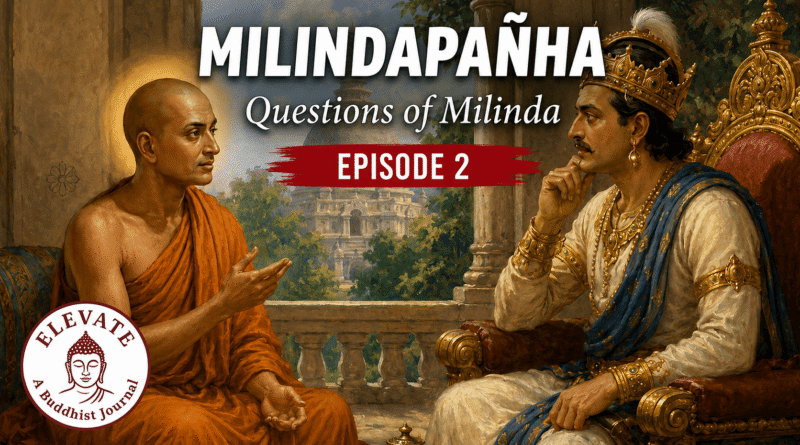
After their remarkable discussion about the chariot, King Milinda continued his dialogue with Nāgasena. He asked, “Nāgasena, how many rains do you have?”
In ancient India, monks counted their years in the monastic life by the number of rainy seasons, or “rains,” they had completed. Nāgasena replied, “Seven, Your Majesty.”
The king immediately asked another question.
“How can you say that seven is yours? Are you seven? Or are the seven years yours?”
It was another clever challenge. If Nāgasena insisted that there was no permanent self, how could he claim to have seven years as a monk?
Instead of answering directly, Nāgasena pointed to something the king could see.
“Your Majesty,” he asked, “your shadow is on the ground. Which is the king—you or the shadow?”
The king replied, “I am the king. The shadow exists because of me.”
Nāgasena said, “In the same way, I am not seven years. The number seven comes into being because of me. It belongs to me in the same way that the shadow belongs to you.”
The king smiled.
Once again, he recognized the wisdom behind Nāgasena’s answer.
At first, this conversation sounds almost like a play on words. But Nāgasena was teaching one of the most important principles in Buddhism.
There are two ways of speaking about reality. The first is conventional truth. This is the language we use every day.
We say,
“This is my house.”
“My friend.”
“My body.”
“My birthday.”
“I am fifty years old.”
These statements are useful. Without them, communication would become impossible. The Buddha himself used this kind of language.
But there is another way of looking. This is called ultimate truth. When we examine things carefully, we find only changing processes. There is no permanent owner behind the body. No permanent thinker behind the thoughts. No permanent self that possesses the years. The number seven is simply a way of describing Nāgasena’s experience in the monastic life.
It is not his identity.
Imagine looking at a calendar.
Today it says July 10.
Tomorrow it says July 11.
Has time itself changed into a different substance? No.
The numbers help us organize our experience. They are useful labels.
In the same way, age is a label. It helps us communicate. But age is not who we are. You are not thirty. You are not fifty.
Those numbers describe the changing journey of your life. They do not define an unchanging self.
Think about a river.
We call it the Mississippi River.
We call it the Ganges.
We call it the Nile.
The name stays the same. But every second, new water flows through it. The river is never exactly the same. Yet we still use one name. The name is conventionally true. The flowing water is ultimately what exists.
Human life is very much like that. We use one name from childhood to old age. Yet the body changes. The mind changes. Our opinions change. Our memories change. Everything changes.
Still we say, “This is me.”
The name is useful. But it should not be mistaken for something permanent.
This teaching is surprisingly practical. Many people struggle with getting older.
They fear wrinkles.
Gray hair.
Birthdays.
Retirement. Why?
Because they believe, “I am getting old.”
The Buddha invites us to look differently. Age belongs to the body. It does not define who we are.
Likewise, success and failure are labels. Job titles are labels. Social status is a label. Even our identities are labels. Useful—but not ultimate. When we cling to labels, we suffer. When we understand them as conventions, we become freer.
Nāgasena did not deny that he had lived as a monk for seven years. He simply refused to confuse a description with an identity. This is an important lesson for all of us. Every day we describe ourselves with labels.
“I am successful.”
“I am a failure.”
“I am young.”
“I am old.”
“I am important.”
“I am insignificant.”
These descriptions may be useful. But they are not the whole truth.
The Buddha teaches us to use conventional language wisely while remembering that beneath all these labels is a constantly changing stream of causes and conditions. When we stop clinging to labels, we begin to discover a deeper freedom.
In our next episode, King Milinda asks an important question that is just as relevant today as it was over two thousand years ago.
He asks Nāgasena, “How should two people discuss the truth?”
Nāgasena’s answer reveals the difference between seeking wisdom… and merely trying to win an argument.
It is a lesson our modern world needs more than ever.
Until next time, may you be well, may you be peaceful, and may the wisdom of the Dhamma illuminate your path.