When Thinking Is Not Enough
Milindapañha, Episode 7 — Reasoning vs. Wisdom
Is being able to reason well the same as being wise?
We live in an age that celebrates intelligence. We analyze, debate, compare, calculate, and argue our way through almost everything.
But here is the deeper question: Can we understand something intellectually and still remain trapped by it?
We may know that anger is harmful—and still become angry.
We may know that attachment causes suffering—and still cling.
We may understand that everything is impermanent—and still resist change.
Perhaps, then, knowing what is true and living according to that truth are not the same thing.
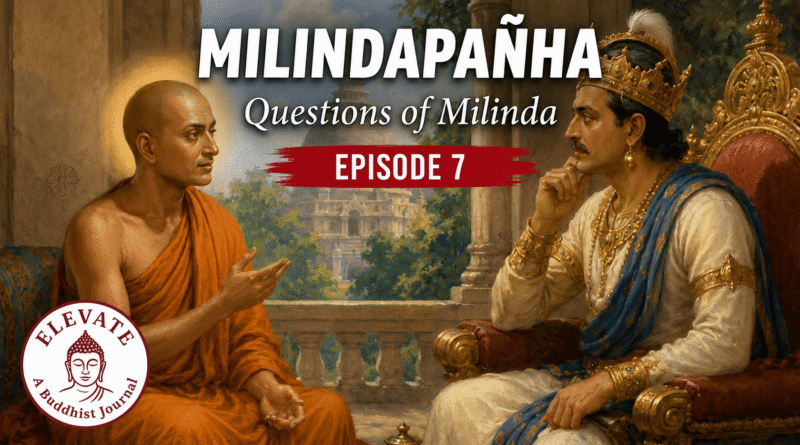
This is precisely the distinction explored by King Milinda and the Buddhist monk Nāgasena.
King Milinda asked Nāgasena:
“Does one who escapes from rebirth do so by the power of reasoning?”
Nāgasena explained that liberation involves not only reasoning, but also wisdom, confidence, virtue, mindfulness, energy, and concentration.
Then the king asked: “Is reasoning the same as wisdom?”
Nāgasena replied: “No. Animals have reasoning but they do not have wisdom.”
When the king asked for the difference, Nāgasena gave a powerful answer: “Taking hold is the mark of reasoning; cutting off is the mark of wisdom.”
He illustrated this with a barley reaper.
The reaper grasps the barley with one hand and cuts it with a sickle in the other.
In the same way, reasoning helps us take hold of the mind, while wisdom cuts through the defilements.
Think about anger.
Reasoning may tell us, “Getting angry will only make things worse.”
But knowing that does not necessarily stop the anger.
Wisdom goes further.
It notices: “Anger has arisen in me. If I continue to hold onto it, I am the one who continues to suffer.”
That recognition begins to loosen its grip.
The same is true with attachment.
We may understand intellectually that everything changes. People change. Relationships change. Circumstances change.
But wisdom is not simply knowing impermanence.
Wisdom is learning to live with impermanence without constantly fighting against it.
And consider an argument.
Reasoning may help us prove that we are right.
But wisdom asks: “Even if I win this argument, what happens to my peace—and what happens to the relationship?”
Sometimes wisdom chooses restraint over victory.
So the practical lesson is simple: Use reasoning to examine. Use mindfulness to observe. Use wisdom to let go.
When something disturbing arises, pause and ask: What is happening in my mind? What am I holding onto? What would wisdom ask me to release?
Because we can know the Dhamma and still remain trapped by our habits. We can understand impermanence and still cling. We can win an argument and still lose our peace.
So perhaps the most important question is not: “How much do I know?”
but: “What has my understanding helped me let go of?”
Reasoning can hold the truth in the mind. Wisdom allows the truth to transform the mind. Reasoning takes hold. Wisdom cuts through. And that is where understanding begins to become freedom.