
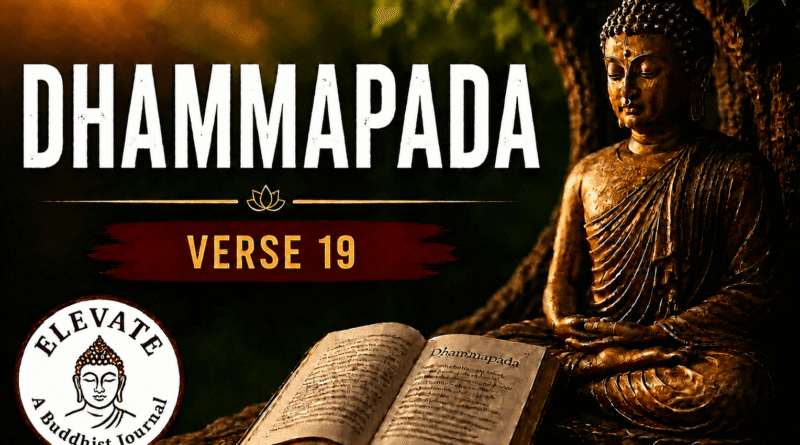
Knowing the Dhamma Is Not Enough
Dhammapada Verse 19
Imagine a person who can talk endlessly about swimming…who knows every technique…
understands every stroke…and can explain exactly how to cross a river.
But that person has never entered the water. Can knowledge alone make someone a swimmer?
The Buddha gives us a similar lesson about spiritual practice. Knowing the Dhamma is valuable. But knowing the Dhamma and living the Dhamma are not the same thing.
In this Episode, we explore Dhammapada Verse 19.
“Though one may recite many teachings, if one does not practice them, one does not share in the fruits of the spiritual life.”
The question is: What is the value of knowing the teachings if we do not allow them to transform our lives?
Two young men from wealthy families became close friends. One day, they heard the Buddha teach and were deeply inspired. They both renounced worldly life and became monks. After several years of training, they approached the Buddha and asked about the duties of a monk. The Buddha explained two important paths: the duty of study and the duty of meditation and practice.
One monk decided to devote himself to meditation. The other chose the path of study. He learned the teachings extensively. He mastered the Buddhist scriptures. He could recite and explain the Dhamma to hundreds of monks. He became highly respected for his knowledge.
But there was one problem. He had learned the Dhamma without fully living it.
The other monk had taken a different path. He practiced diligently. He cultivated his mind. And through that practice, he eventually attained arahantship.
One day, the Buddha questioned both monks about deeper stages of spiritual realization. The learned monk could answer questions about the scriptures and teachings… but when the questions turned to direct spiritual experience, he could not answer. The practicing monk could.
The Buddha praised him. Why? Because the purpose of Dhamma is not simply to fill our memory. It is to transform our lives.
The Buddha gave a powerful comparison. A person who knows the teachings but does not practice them is like a cowherd. The cowherd counts another person’s cattle. He takes care of them. He leads them to pasture. But he does not own the cattle…and he does not enjoy their milk.
In the same way, we can memorize teachings…discuss meditation…talk about compassion…and explain the Four Noble Truths…but if we do not practice them, we do not experience their true fruits.
So ask yourself: “Am I simply collecting Dhamma…or am I practicing it?”
When anger arises…do I remember the teaching on letting go?
When someone hurts me…do I practice compassion?
When attachment appears…do I recognize it?
The Buddha’s teachings are not meant merely to be heard, memorized, or repeated. They are meant to be lived. Knowing Dhamma gives us direction. Practicing Dhamma changes the journey.
And that is the difference between knowing the path…and actually walking it.

I think the same is true of Christianity or any religious, spiritual or moral philosophy. Wise advice!