
Buddhist News Roundup
Bhikkhu Paññākāra Brings the Message of Peace to 13th Global Buddhist Conference in Poland
KRAKÓW, Poland — November 14, 2026
Following the conclusion of the Walk for Peace across the United States earlier this year, Ven. Bhikkhu Paññākāra has continued sharing its message of peace with international audiences. From November 6–8, he joined Buddhist monks, nuns, scholars, meditation teachers, and practitioners at the 13th Global Buddhist Conference in Kraków, Poland.
Held at the ICE Kraków Congress Centre, the three-day conference brought together nearly 1,500 participants, according to the City of Kraków. It was the first Buddhist conference of this scale to be organized in Poland.
Ven. Paññākāra took part in several sessions during the gathering. On November 7, he delivered a talk titled The Peace We Carry Within, focusing on the cultivation of inner peace. The following day, he led a mindfulness meditation session and joined a panel discussion titled Is the Modern World Ready for Mettā, Loving-Kindness?
The panel also featured Buddhist teachers Ajahn Brahm, Ayyā Kāruṇikā, and Ven. Ariyadhammika. The discussion explored the relevance of mettā, or loving-kindness, in contemporary life. Further details of the panel discussion are available in the Dhammacetiya report, Walk for Peace in Kraków: Arrival and the Mettā Panel Discussion.
The conference featured talks, meditation sessions, and discussions on Buddhist teachings and their place in today’s world. Among the other speakers was Ajahn Brahm, abbot of Bodhinyana Monastery in Australia. Participants represented several Buddhist traditions and countries.
The gathering was organized by the Theravāda Foundation of Warsaw and the Polish Association of Early Buddhism.
For Ven. Paññākāra, the conference provided another opportunity to share the message associated with the Walk for Peace beyond the United States. His participation also brought the pilgrimage’s emphasis on peace and loving-kindness into a wider conversation among Buddhist teachers and practitioners.
Sources and Further Reading
1. Dhammacetiya – Walk for Peace in Kraków: Arrival and the Mettā Panel Discussion.https://dhammacetiya.com/walk-for-peace-in-krakow-arrival-and-the-metta-panel-discussion/?utm_source=chatgpt.com
2. City of Kraków – In Search of Wisdom and Inner Peace, November 12, 2026. https://krakow.pl/krakow_open_city/news/345493%2C245%2Ckomunikat%2Cin_search_of_wisdom_and_inner_peace.html?utm_source=chatgpt.com
3. 13th Global Buddhist Conference – Official conference https://buddha2026.org/en/news/?utm_source=chatgpt.comce website.

Vietnam Buddhist Sangha Restructures Its Organization
HO CHI MINH CITY, Vietnam — November 14, 2026
The Vietnam Buddhist Sangha (VBS) has approved a major organizational restructuring for its 2026–2031 term, simplifying its administrative structure from four levels to three.
The decision was announced during the organization’s 10th National Buddhist Congress, held November 5–7 in Ho Chi Minh City, which also marked the 45th anniversary of the Sangha’s establishment in 1981.
One of the main changes in the new restructure is the removal of the district-level administrative structure, aligning the Sangha’s organization with Vietnam’s revised local government system. Its new structure will consist of central, provincial or municipal, and local levels.
The congress also approved a revised organizational Charter, reducing it from 14 chapters and 87 articles to 12 chapters and 70 articles.
For the 2026–2031 term, the congress elected 235 members to the Executive Council and 40 alternate members. Most Venerable Thích Thiện Nhơn was re-elected as president of the Executive Council.
The Sangha also identified digital transformation, Buddhist education, Dharma propagation, international cooperation, and social welfare as important priorities for the new term.
The VBS, established in 1981 is one of Southeast Asia’s largest national Buddhist organizations.
According to reports published in October 2026, it encompasses approximately 65,000 monks and nuns, nearly 19,000 temples and monasteries, and 250 registered locations for collective religious activities. Its membership brings together several Buddhist traditions that historically maintained separate institutions, including Mahayana Buddhism, Vietnamese and Khmer Theravada Buddhism, and the Vietnamese Mendicant (Khất sĩ) tradition. Other constituent traditions include Vietnamese traditional Buddhism and the Thiên Thai school. Although Mahayana Buddhism represents the largest component, the Sangha’s organizational structure accommodates different Buddhist practices and lineages. It was established through the unification of nine Buddhist organizations and associations, making it an important umbrella institution in Vietnam’s Buddhist landscape.
Sources and Further Reading
1. Vietnam News, Vietnam Buddhist Sangha restructures for new five-year term, November 2026. Read the report
2. Nhân Dân, Viet Nam Buddhist Sangha approves list of 235 members of Executive Council for 2026–2031 term, November 2026. Read the report
3. VietnamNet, Vietnam Buddhist Sangha marks 45 years of unity and global engagement, 2026. https://vietnamnet.vn/en/vietnam-buddhist-sangha-marks-45-years-of-unity-and-global-engagement-2571366.html VietnamNet report
Sacred Relics of the Buddha Arrive at Golden Pagoda in India’s Arunachal Pradesh
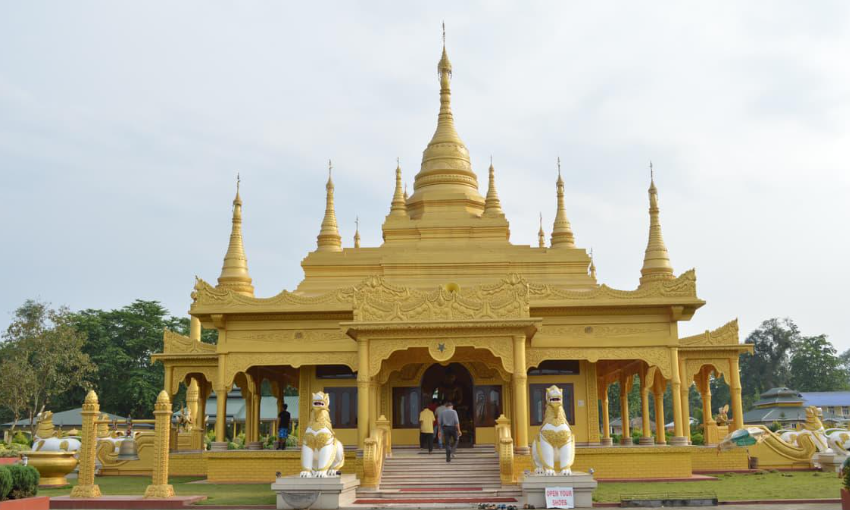
The sacred relics of Shakyamuni Buddha arrived at the Golden Pagoda in Namsai, Arunachal Pradesh, on November 14, beginning the final stage of a three-location exposition across the northeastern Indian state.
The relics, known as the Piprahwa relics, were brought from the National Museum in New Delhi following public expositions at Tawang Monastery and Thubchog Gatsel Ling Monastery in Bomdila. They will remain at the Golden Pagoda for public veneration through November 20 before returning to the National Museum on November 21.
The exposition began on October 31, when the relics arrived at the historic Gaden Namgyal Lhatse Monastery in Tawang. According to India’s Ministry of Culture, approximately 31,000 devotees and visitors paid their respects during the seven-day exposition there, which concluded on November 7.
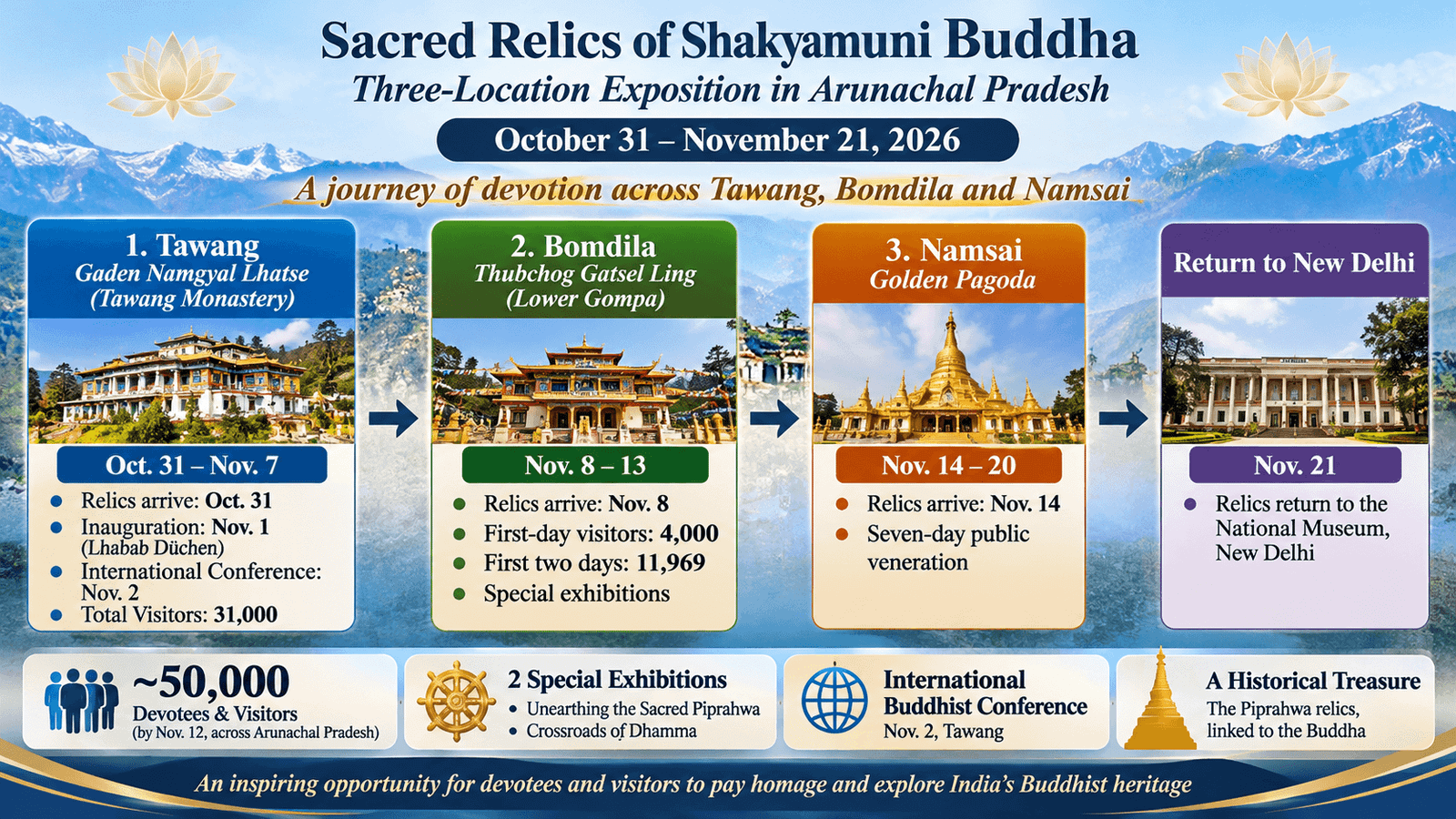
The relics subsequently moved to Bomdila, where they were enshrined at Thubchog Gatsel Ling Monastery from November 8 to 13. Approximately 4,000 devotees visited the monastery on the first day of the exposition.
The Piprahwa relics were discovered in 1898 by British engineer William Claxton Peppe during excavations of an ancient Buddhist stupa at Piprahwa in present-day Uttar Pradesh. The site is associated with ancient Kapilavastu and the Shakya clan to which the Buddha belonged. An inscription found on one of the reliquaries refers to the relics of the Buddha and their enshrinement by members of the Shakya clan.
The exposition is organized by India’s Ministry of Culture in collaboration with the Government of Arunachal Pradesh, the International Buddhist Confederation (IBC), and the National Museum in New Delhi. Special exhibitions accompanying the exposition also present the archaeological discovery and historical significance of the relics.
The initiative provides Buddhist communities and visitors in India’s northeastern Himalayan region an opportunity to pay homage to the Buddha’s relics and learn more about the country’s Buddhist heritage.
Sources and Further Reading
1. The Print / Press Trust of India, November 14, 2026 — Sacred Buddha relics arrive in Arunachal’s Namsai for exposition. Sacred Buddha relics arrive in Arunachal’s Namsai for exposition
2. Press Information Bureau, Government of India, November 8, 2026 — 31,000 Devotees Seek Blessings of the Sacred Relics of Shakyamuni Buddha at Tawang, Arunachal Pradesh. 31,000 Devotees Seek Blessings of Sacred Relics at Tawang
3. Press Information Bureau, Government of India, November 9, 2026 — Sacred Relics of Shakyamuni Buddha Arrive at Thubchog Gatsel Ling (TGL) Monastery, Bomdila. Sacred Relics Arrive at Bomdila Monastery
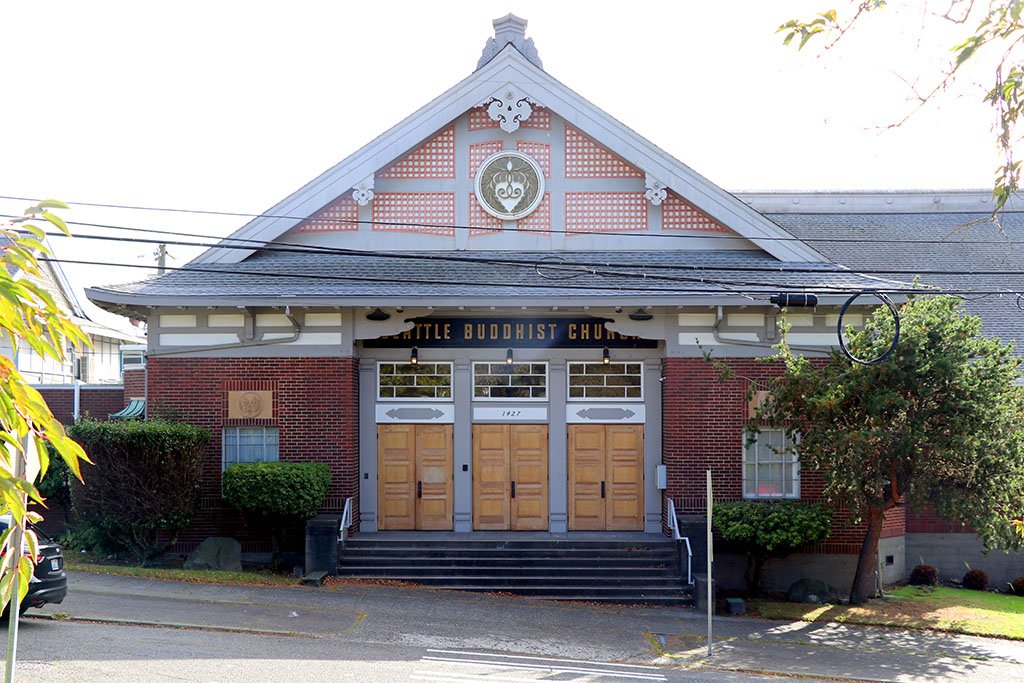
Seattle Betsuin Buddhist Temple Marks 125 Years of Japanese Buddhist Heritage
SEATTLE, Washington — November 14, 2026
Seattle Betsuin Buddhist Temple, one of the oldest Japanese Buddhist institutions in the Pacific Northwest, celebrated its 125th anniversary on November 8, marking more than a century of preserving Japanese Buddhist traditions and serving the local community.
Established in 1901 by Japanese immigrants, the temple traces its beginnings to November 15 of that year, when Rev. Kakuryo Nishijima conducted the first Jōdo Shinshū Buddhist service in the Pacific Northwest. The congregation initially gathered in a rented building in Seattle’s Chinatown-International District.
The temple follows the Jōdo Shinshū tradition, a major school of Japanese Pure Land Buddhism that emphasizes the teachings of Shinran Shōnin and devotion to Amida (Amitābha) Buddha.
Its history is closely connected with the experiences of Japanese Americans during World War II. The temple’s present building was dedicated in October 1941. Following the forced removal and incarceration of Japanese Americans during the war, the building was taken over by the U.S. Maritime Commission and used as its office from 1942 to 1946. The congregation later resumed its activities and continued serving the community.
The November 8 anniversary celebration included an Eitaikyō Hōyō and Muen Hōyō memorial service honoring deceased members, a temple rededication ceremony, and a commemorative luncheon and fundraiser. The service featured Rev. Marvin Harada, bishop of the Buddhist Churches of America, and the temple’s head minister, Rev. Katsuya Kusunoki, along with former temple ministers.
The anniversary marks the beginning of a year-long observance under the theme, “Honoring the Past, Inspiring the Future — 125 Years of Nembutsu.” Planned activities through October 2027 include educational and cultural programs, historical exhibitions, and activities intended to encourage younger generations to connect with the temple.
The congregation has also faced recent challenges. A fire in late 2023 forced members to hold services in other community facilities while the main temple underwent restoration. Despite these difficulties, the temple continues its efforts to preserve its Buddhist heritage and maintain its role as a gathering place for future generations.
Sources and Further Reading
1. Seattle Betsuin Buddhist Temple – A Brief History. Seattle Betsuin Buddhist Temple – A Brief History
2. FāVS News, November 9, 2026 – Seattle Betsuin Buddhist Temple Turns 125, Looks to Its Next Generation. Seattle Betsuin Buddhist Temple Turns 125, Looks to Its Next Generation
3. Seattle Betsuin Buddhist Temple – 125th Anniversary Celebration. Seattle Betsuin – 125th Anniversary Celebration
4. The Seattle Times, October 15, 2026 – Seattle Buddhist Church Marks 125 Years of Change as Japanese Community Hub. Read the article – Seattle Buddhist Church marks 125 years of change as Japanese community hub
International Temples Day Celebrated Across Several Countries
Kadampa Buddhist communities in several countries marked International Temples Day in early November with prayers, meditation sessions, Dharma teachings, and community gatherings. Celebrated annually on the first Saturday of November, the occasion recognizes the International Temples Project, an initiative established by Venerable Geshe Kelsang Gyatso Rinpoche to support the development of Buddhist temples and Dharma centers around the world.
According to the New Kadampa Tradition (NKT), celebrations this year took place at centers across the United States, Mexico, Brazil, and other countries. Activities included guided meditation, special prayers dedicated to world peace, temple tours, and opportunities for local communities to come together. Some centers also organized additional activities, including the opening of a new gazebo.

The International Temples Project aims to make Buddhist teachings and meditation accessible to a wider public. Its network includes temples and Dharma centers in different parts of the world. The annual observance reflects the NKT’s emphasis on creating spiritual spaces where people can study Buddhist teachings and develop inner peace.
International Temples Day is an initiative of the New Kadampa Tradition rather than a universal Buddhist observance.
Sources and Further Reading
1. New Kadampa Tradition, “Coming Together to Celebrate International Temples Day,” November 13, 2026 — reports on celebrations at Kadampa communities around the world.
2. New Kadampa Tradition, “Rejoicing in the International Temples Project,” November 14, 2026 — details celebrations at six centers in the United States, Mexico, and Brazil.
3. New Kadampa Tradition, “International Temples Day” — background on the annual observance and the purpose of the International Temples Project.


Bonjour
Appreciate the feedback news regarding the congress.
I am surprised that you talk about the knew Kadampa tradition since it has validity issues regarding the reincarnation.
But i am glad that your journal is open to talk about others type of buddhism.
May you be well, happy and peaceful!