

Can a Virtual Temple Be a Buddhist Temple?
Elevate News Desk
One year after Buddhist monks began their Walk for Peace from Fort Worth, Texas, a virtual Buddhist temple opened in South Korea. Though unrelated, the two events offer a striking contrast between physical encounters with Buddhist practice and the growing appeal of digital spiritual spaces.
On October 26, 2025, a group of Buddhist monks left the Huong Dao Vipassana Bhavana Center in Fort Worth, Texas, and began a journey that would take them roughly 2,300 miles to Washington, D.C. Their Walk for Peace would last for months, carrying a message of compassion, unity and peace through towns and cities across the United States. People came out to meet the monks, offer food, walk alongside them and spend a few moments in their company listening to the Dhamma talk.
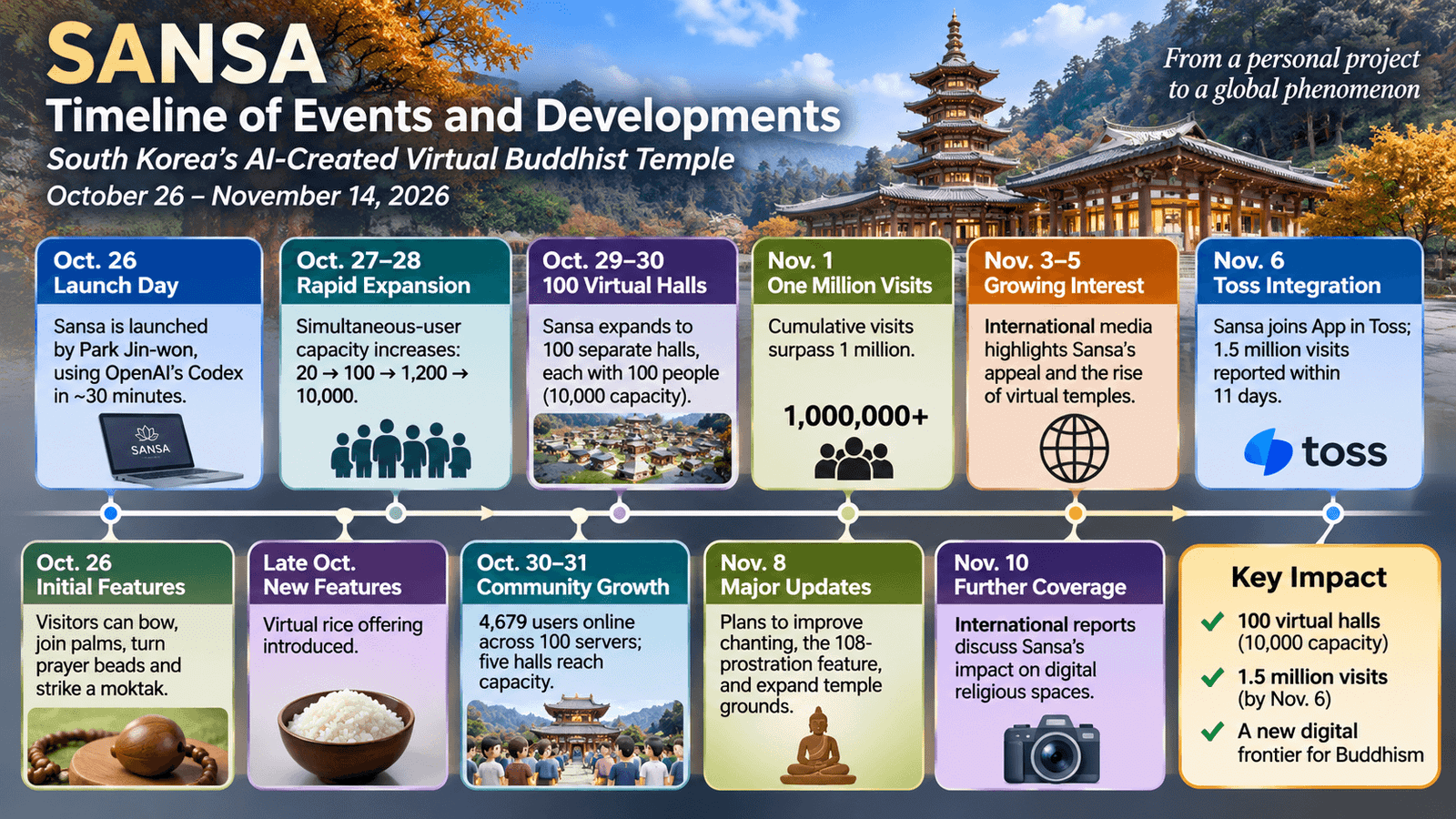
Exactly one year later, on October 26, 2026, another journey began, though this one required no walking, no road map and no physical gathering. In South Korea, a young man named Park Jin-won opened Sansa, a virtual Buddhist temple that visitors could enter through a web browser.
The coincidence of dates is striking. Clearly, the two events are not connected, and their purposes and circumstances are quite different. Yet placing them side by side offers an interesting way to consider how people encounter Buddhism today.
One journey brought Buddhist monks into public spaces, where they met people face to face. The other created a digital space where visitors could enter a temple, bow, turn prayer beads or simply sit quietly. One depended on physical presence and the effort of travelling together and focuses on peace, compassion, healing and unity. The other removed almost every barrier to entry and focuses on prayer and quite place.
Both, in their own ways, invite people to pause.
A temple on the screen
Sansa appeared at a time when many people were already accustomed to finding almost everything online. Few people may have expected to find a Buddhist temple among the things they could visit through an ordinary web browser.
The setting resembles a traditional temple, with a large Buddha image at the centre of the main hall and a forest landscape surrounding it. Visitors enter through avatars modelled on young Buddhist novices. They can put their palms together, bow, turn prayer beads and take part in other simple activities associated with Buddhist worship.
There is no need to travel, arrange a visit or know the customs of a particular monastery. A person can enter for a few minutes and leave whenever they wish.
The response was remarkably quick. South Korean media reported that Sansa received more than 900,000 cumulative visits by October 31, five days after its launch. Reports subsequently put the figure above one million, and later above 1.5 million within eleven days of launch (November 4). These figures refer to reported visits, not necessarily to that number of different individuals.
Park, 26, studied English literature and was looking for work when he developed the site. Reports describe him as using AI-assisted programming, often called “vibe coding”, to build the service. His idea came from a personal wish: sometimes he wanted to visit a temple and rest, but did not have the time or energy to make the journey.
Interestingly, Park himself is not a Buddhist, a detail reported by South Korean media. His project therefore raises an additional question: what does it mean when someone outside a religious tradition creates a space that attracts so many people seeking a religious or contemplative experience?
What makes Sansa particularly interesting is how it began. Park was not setting out to establish a religious institution or create a new form of Buddhist practice. He simply wanted a quiet place to visit when he felt too tired or busy to go to an actual temple.
The scale of the response suggests that the feeling was familiar to many others.
What do we mean by a temple?
The popularity of Sansa is easy to understand at one level. A visitor does not have to make a commitment, explain their beliefs or take part in a group activity. The temple is available at any hour, and the experience can be as brief or as long as the visitor chooses.
But a Buddhist temple is more than a peaceful building.
For generations, temples have been places where people gather to hear teachings, observe ceremonies, practice meditation, make offerings, receive guidance and take part in the life of a community. They are also places where Buddhist traditions are preserved and passed from one generation to the next. A monastery is shaped by the people who live and practice there, not simply by its architecture or atmosphere.
That raises a question that cannot be answered simply by looking at the temple on a screen.
A person can make a virtual bow with a click. But what does that action mean to the person performing it? Is it an expression of reverence, a moment of reflection, a familiar ritual recreated for convenience, or simply an activity inside a computer program?
The answer may differ from one visitor to another.
From a Buddhist perspective, the value of an action cannot be judged entirely by where it takes place. Intention, understanding, and the mental qualities cultivated through that action also matter. A person who enters a virtual temple with reverence and spends a few moments reflecting on the Dhamma may benefit from that experience. At the same time, clicking a button to perform a virtual bow does not automatically cultivate mindfulness, wisdom, or devotion. As with any religious practice, what matters is not simply the action itself, but the state of mind behind it and whether it contributes to a more wholesome way of living.
Buddhist practice has never been limited to one setting. People practice at home, in temples, in workplaces and while travelling. They listen to teachings through recordings, join online meditation sessions and communicate with teachers across great distances. Digital platforms have already become part of the way Buddhist communities share information and maintain contact.
Sansa takes this a step further. Instead of simply making Buddhist teachings available online, it attempts to recreate the experience of entering a temple, allowing visitors to participate in simple religious activities through their avatars.
That may be a useful first encounter. It may also be where the experience ends.
A virtual temple cannot, by itself, provide the guidance of a teacher, the discipline of regular practice or the responsibilities that come with belonging to a community. Nor can a digital representation fully reproduce the experience of entering a physical temple, hearing the sounds of a ceremony, making an offering in person or meeting someone who has devoted their life to the Dharma.
There is certainly value in making such an experience accessible, particularly to people who might otherwise never enter a temple. Still, we should not confuse a digital representation of Buddhist worship with the fuller experience of learning and practicing within a Buddhist community.
The appeal of being left alone
Perhaps one of the most interesting things about Sansa is that visitors do not have to interact with anyone.
People share the virtual space, but the experience does not depend on conversation. Visitors can be present alongside others without having to introduce themselves, explain why they have come or maintain a social exchange.
For someone who is tired, lonely or overwhelmed, that may be part of the attraction. A physical temple can offer a similar welcome, but reaching it requires time and, in some circumstances, confidence about entering an unfamiliar religious setting.
A virtual temple removes some of that hesitation.
There is also a distinction between seeking the atmosphere of a temple and seeking the teachings of the Buddha. Someone may visit Sansa because it offers a peaceful escape from a demanding day, without having any particular interest in Buddhism. Another visitor may approach it with genuine religious devotion. Both are welcome, but their motivations may be quite different. The number of visits alone cannot tell us how many people are developing an interest in Buddhist practice
Yet Buddhism is not only a search for personal calm. The teachings place considerable importance on our relationship with others, on compassion and on the understanding that our lives are connected. The Sangha is not simply a collection of individuals seeking private comfort. It is a community that supports practice and helps people remain on the path.
This is where Sansa presents an interesting tension. Its appeal may lie partly in allowing people to experience a temple without having to join a community. Whether that experience encourages them to take a further step towards Buddhist practice remains an open question.
The importance of human encounter
The Walk for Peace offered something that cannot easily be reproduced online: the opportunity to encounter Buddhist monastics in everyday life.
People did not have to visit a monastery or attend a formal religious gathering. The monks came through their communities, and people could approach them, offer food, ask questions, or simply walk alongside them. These ordinary human encounters became part of the experience.
For many, the opportunity to meet the monks was not just about listening to a Dhamma talk. It was about seeing Buddhist values expressed through conduct: the monks’ discipline, patience, humility, and willingness to continue walking day after day. People from different backgrounds and beliefs found opportunities to connect through a shared wish for peace.
This kind of encounter creates a relationship between the visitor and the wider Buddhist community. It allows people to experience generosity, compassion, and fellowship in ways that extend beyond the act of visiting a religious space.
A virtual temple may introduce someone to Buddhist symbols and simple devotional activities. But a physical encounter with practitioners can also offer an example of how the teachings are lived.
Two journeys, one date
The Walk for Peace and Sansa share an unusual coincidence: both began on October 26, exactly one year apart. Their timing may mean nothing, but the difference between the two experiences tells us something about the many ways people seek peace and spiritual connection today.
The monks who left Fort Worth on October 26, 2025 did not offer people a shortcut to peace. They walked through communities, met strangers and continued along the road day after day. Their presence was physical, public and demanding.
Sansa offers something very different. It asks little of its visitors. They can enter from home, spend a few minutes in a virtual prayer hall and leave without speaking to anyone.
A peace walk and a virtual temple are not interchangeable forms of Buddhist practice. One brings people together through shared physical effort; the other offers a quiet space that can be entered from almost anywhere. Perhaps the more important question is not whether a virtual temple can replace a physical one, but whether the moments people spend there might encourage them to look more deeply into the teachings of the Buddha—and eventually bring those teachings into their daily lives.


I do not have access to a physical temple. It is hours away and impossible for me to visit given my caregiver responsibilities. I realize that only having a connection through social media has its advantages but it doesn’t replace the needed connection a temple can offer. Social media can present issues of incorrect teachings and scams. It’s wonderful there is such an easy way to discover Buddhism but, as with anything social media offers, us it is never a replacement for personal connection.
Interesting article! As a Catholic, also following Buddhism, I can attest to the attraction of meeting the Walk-for-Peace pilgrims on the road. At the same time, consider that it’s also possible to form connections with people digitally. I joined Bellarmine Chapel in Cincinnati, Ohio (8 hours away from me) during the pandemic and have been a member ever since. I’ve been involved with the parish Social Mission ministry, a centering prayer group and other temporary groups and events… all online. I only visited the parish (in-person) one time, yet I still know a variety of people that some parishioners, who attend in person, don’t know. Zoom and other videoconferencing platforms are amazing resources for spiritual community, and they are vital for the homebound and elderly. It’s helping me get to know the Buddhist network as well.