
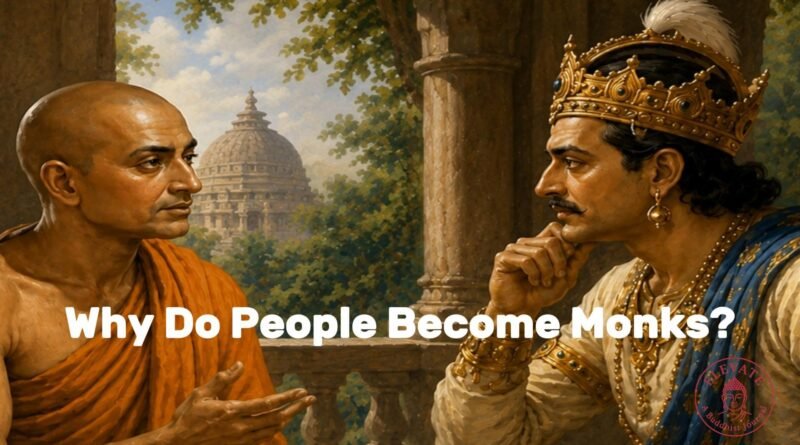
Why Do People Become Monks?
Milindapañha, Episode 5
Why would someone give up wealth, career, family, and worldly pleasures to become a monk?
Is it because they are escaping life’s problems?
Are they avoiding responsibility?
Or is there a deeper purpose behind the Buddhist monastic life?
King Milinda asked this very question, and Nāgasena gave an answer that is as honest as it is profound.
King Milinda asked Venerable Nāgasena, “What is the purpose of your going forth, and what is the final goal you seek?”
Nāgasena replied, “Our going forth is for the purpose that this suffering may be extinguished and that no further suffering may arise. The complete ending of attachment is our final goal.”
The king then asked another important question. “Does everyone become a monk for such noble reasons?”
Nāgasena answered with remarkable honesty. “No.” He explained that some people join the monastic Order to escape oppressive rulers. Others seek protection from robbers. Some wish to escape debt. Others simply hope for a better livelihood.
“But,” Nāgasena concluded, “Those who enter rightly do so for the complete extinction of attachment.”
Nāgasena’s answer is refreshingly realistic.
He doesn’t pretend that everyone begins the spiritual journey with perfect intentions. People come to the Dhamma carrying fear, disappointment, loss, curiosity, or even desperation.
Some arrive seeking safety. Some seek peace. Some simply seek a better life.
But what matters most is not why we begin. What matters is where the path ultimately leads. The true purpose of the Buddhist life is not to escape the world—it is to free the mind from greed, hatred, and delusion.
This lesson applies not only to monks but to all of us.
Many people first turn toward meditation or Buddhism during difficult times. Perhaps after losing a loved one. After a painful divorce. After burnout from work. Or when anxiety and stress become overwhelming.
At first, we may simply want relief from suffering. There is nothing wrong with that.
But if we continue practicing, we gradually discover that the deepest transformation comes not from changing our circumstances, but from changing the mind itself.
The path begins with suffering—but it ends with freedom.
The Buddha taught that suffering does not arise because the world is imperfect. It arises because the mind clings. We cling to pleasure. We cling to possessions. We cling to relationships. We even cling to our opinions and our identity.
When attachment ends, suffering ends. This is why Nāgasena said that the highest goal of the monastic life is the complete extinction of grasping.
That goal is not reserved only for monks. It is the ultimate aim of every sincere practitioner of the Dhamma.
Ask yourself: Why did I first become interested in Buddhism or meditation?
Was it curiosity? Stress? Loss? The search for meaning?
Whatever brought you to the path, remember that the destination is far greater than the reason you started.
In our next episode, King Milinda asks another profound question: Who is reborn after death?
If Buddhism teaches that there is no permanent self, then what continues from one life to the next? Nāgasena’s answer offers one of the deepest explanations of rebirth found anywhere in Buddhist literature.
Thank you and I look forward to the next✌️❣️🙏