
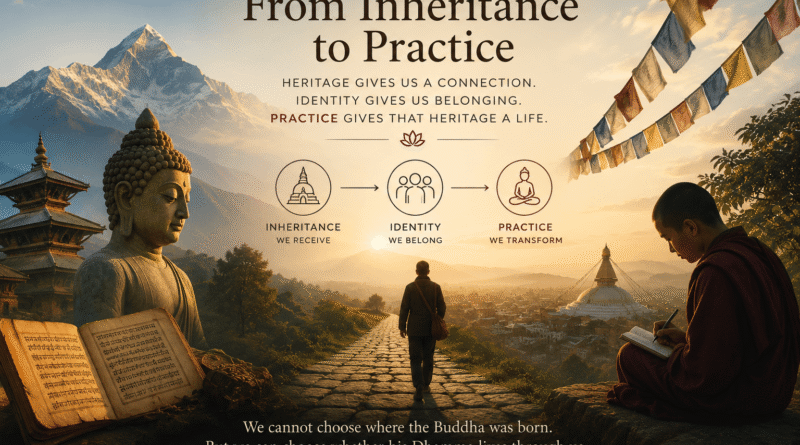
From Inheritance to Practice
By Dr. Neeraj Bajracharya
This article is adapted from the keynote address delivered by the author at the Non-Resident Nepali Association (NRNA) Knowledge Convention during its 15th Annual General Meeting.
Nepal is the land of Mount Everest and the birthplace of the Buddha.
For many Nepalis living abroad, these are among the first words we use when introducing our country. They are words filled with understandable national pride. Mount Everest represents the extraordinary geography of our homeland; the Buddha represents a spiritual heritage whose influence has extended far beyond Nepal’s borders.
But there is a deeper question that we do not always ask: What responsibility comes with claiming the land of the Buddha’s birth as our heritage? Is it enough to celebrate a historical fact? Is it enough to tell the world that the Buddha was born in Nepal? Or does such an inheritance place upon us a responsibility to embody the values associated with his awakening—wisdom, compassion, ethical conduct, and peace?
I believe the answer lies not in how proudly we claim the Buddha, but in how faithfully we live what he taught.
The Question That Changed My Understanding
Like many immigrants, I came to the United States in pursuit of higher education and professional opportunities. I earned a Ph.D. in Mathematics, became a university professor, and later worked as an industry consultant. My academic and professional life taught me to value inquiry, reasoning, and disciplined thinking. Yet, despite growing up in a traditional Newar Buddhist family, I had never subjected my own Buddhist inheritance to the same kind of deliberate inquiry.
That changed one summer evening in 2014.
A visiting friend asked me a seemingly simple question in Nepali: “Buddha le Panchasheel auta diye ta ho ni, aru ke nai diye chha ra?”
In essence: “The Buddha gave the Five Precepts, but what else did he really give us?”
The question was simple. My inability to answer it was not. I had grown up with deep reverence for the Buddha. I knew the rituals, traditions, stories, and cultural practices associated with Buddhism. But that moment forced me to confront an uncomfortable truth: reverence is not the same as understanding. I could claim the Buddha as part of my heritage, but could I clearly explain what he had actually discovered and offered to humanity?
That question stayed with me.
In retrospect, it became my own “Newton’s apple”—an ordinary encounter that triggered a much larger intellectual journey.
What Did the Buddha Actually Give the World?
The Buddha contribution was far more than a collection of ethical rules. The Five Precepts are an essential foundation for ethical living, but the Buddha’s contribution extends much further. He investigated the human condition with remarkable depth: Why do we suffer? What gives rise to suffering? Can suffering come to an end? And if it can, what path leads to that freedom?
The Buddha’s teaching begins with the recognition of suffering, but it does not end there. It examines its causes, points toward its cessation, and provides a path of practice. The Four Noble Truths are therefore not merely propositions to accept; they point to a process of understanding and transformation. In this sense, the Dhamma is not merely something to believe. It is something to investigate, understand, and practice.
The Buddha’s contribution was not simply to tell people to be peaceful or compassionate. He showed us how suffering is connected to the way we perceive, desire, cling, and react—and how transforming the mind can transform the way we live. Peace, from this perspective, is not merely the absence of conflict between nations. It begins much closer to home—in the mind, in our speech, in our actions, and in the way we relate to other human beings.
This realization changed the way I understood my own Buddhist heritage. I began to see that inheriting Buddhism is not primarily about possessing a cultural identity. It is about accepting an invitation to practice.
Heritage Is Not the Same as Accomplishment
Being connected to the birthplace of the Buddha is a remarkable inheritance. But inheritance is not accomplishment. We did not choose where we were born. We did not personally create the traditions we inherited from previous generations. We received them.
And whatever we receive from previous generations carries a responsibility: to understand it, preserve what is valuable, and pass it forward in a meaningful form.
For Nepalis, particularly those connected to Nepal’s Buddhist traditions, this responsibility has a distinctive historical dimension. Nepal is home to rich and continuous Buddhist traditions, including Newar and Himalayan Buddhist traditions that have preserved texts, rituals, art, philosophy, architecture, and practices across centuries. Yet much of this heritage remains unfamiliar to the wider world.
Preserving this heritage matters. But preservation alone is not enough. A tradition can survive outwardly while becoming disconnected from the values that gave it life. The question, therefore, is not simply how to preserve our heritage, but how to keep it alive.
From Pride to Responsibility
My own understanding of responsibility has developed in several directions.
Preserving Heritage: We have a responsibility to introduce the richness of Nepal’s Buddhist traditions to the wider world—not simply as cultural artifacts, but as living traditions with philosophical depth and contemporary relevance. This requires documentation, scholarship, education, translation, and dialogue.
It also requires moving beyond the assumption that everyone understands Buddhism simply because the Buddha was born in Nepal.
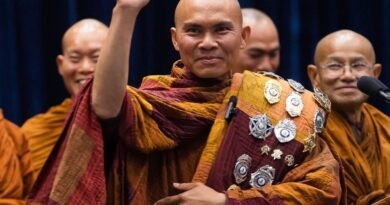
Fostering Unity: Our Buddhist communities are diverse. Different countries and traditions have developed different languages, rituals, practices, and interpretations. Yet diversity does not have to become division. My experience with the Walk for Peace reinforced this conviction. Monks and supporters from different Buddhist traditions and countries were able to walk together around a shared aspiration for peace, compassion, unity, and healing.
We do not need to erase our differences in order to work together. We need to discover what our differences can contribute to a larger common purpose.
Empowering Scholarship: If Buddhism is to remain a living intellectual and spiritual tradition, we must create opportunities for serious study.This conviction led me to establish Elevate: A Buddhist Journal, as a platform for Buddhist scholarship, including the work of Nepalese Buddhist scholars whose contributions deserve a wider audience.
Scholarship is not separate from practice. Understanding our history, texts, philosophies, and traditions helps us distinguish what is essential from what is merely customary.
Living the Values: But preservation, unity, and scholarship ultimately point toward the same destination: practice. The Buddha’s teachings cannot be fully preserved merely in books, temples, museums, conferences, or journals. They must be preserved in human conduct. If we speak about compassion but treat others with contempt, what have we preserved? If we speak about peace while nurturing hatred, what have we understood? If we celebrate the Buddha while ignoring ethical conduct, have we really honored him?
These questions apply not only to Nepalese. They apply to all of us who call ourselves Buddhists.
From Buddhist Identity to Buddhist Practice
There is an important distinction we need to make when we speak about being Buddhist. We can be connected to Buddhism in at least three different ways.
The first is Buddhism as inheritance. We may be born into a Buddhist family, grow up surrounded by Buddhist traditions, visit temples, participate in festivals, and inherit stories, rituals, art, and customs from generations before us. This inheritance is precious. It gives us a connection to a remarkable spiritual and cultural tradition.
The second is Buddhism as identity. At some point, we may consciously say, “I am Buddhist.” We may identify with a particular Buddhist tradition, belong to a Buddhist community, study Buddhist teachings, or participate in Buddhist organizations. Identity gives us a sense of belonging.
But there is a third and deeper dimension: Buddhism as practice.
Inheritance gives us a heritage. Identity gives us belonging. Practice gives that heritage a life. To practice Buddhism is to allow the Dhamma to transform the way we see ourselves, other people, and the world. It means cultivating wisdom rather than ignorance, compassion rather than cruelty, mindfulness rather than heedlessness, and non-hatred rather than resentment. It means allowing ethical conduct to become part of our everyday lives rather than something we merely admire in the Buddha.
These three dimensions are not mutually exclusive. Inheritance can lead to identity, and identity can lead to practice. But the journey should not stop at inheritance or identity. If we call ourselves Buddhists, the most important question is ultimately not What Buddhist tradition do I belong to? or even How long have I identified as Buddhist? The deeper question is: How much of the Dhamma is visible in the way I live?
This responsibility belongs to all Buddhists. It does not matter whether we are Nepalese, Sri Lankan, Thai, Burmese, Vietnamese, Tibetan, Chinese, Japanese, Korean, European, African, American, or from any other part of the world. Our traditions may differ in language, culture, rituals, and methods of practice. But if we identify ourselves as Buddhists, we share a responsibility to keep the Dhamma alive through our conduct.
A Buddhist who responds to anger with greater understanding is practicing the Dhamma. A Buddhist who chooses compassion when hatred would be easier is practicing the Dhamma. A Buddhist who listens across differences, speaks truthfully, acts ethically, and works to reduce suffering is practicing the Dhamma.
In this sense, every practicing Buddhist can become a peace ambassador—not because we have been given a title, but because our conduct becomes a small expression of the peace we wish to see in the world.
Beyond the Birthplace
My journey began with a simple question in 2014: What did the Buddha really give us?
I am still exploring that question. But I have come to understand that the answer cannot be found simply by pointing to Lumbini, recounting the Buddha’s biography, building and preserving monuments, celebrating festivals, or taking pride in our Buddhist heritage. All of these have value. They connect us to history and help preserve what previous generations entrusted to us.
But heritage is only the beginning. The Buddha’s birthplace belongs to history. The Dhamma belongs to practice.
For those of us connected to Nepal, honoring the Buddha’s birthplace therefore means more than telling the world where the Buddha was born. It means asking what we are doing with the inheritance we have received. And for every person who calls themselves Buddhist, the responsibility is even more universal: to transform admiration into understanding, understanding into practice, and practice into a way of life.
Perhaps the most meaningful way to honor the Buddha is not simply to claim him as part of our heritage. It is to become, through our own conduct, evidence that his teachings still have the power to transform human beings.
We cannot choose where the Buddha was born. But we can choose whether his Dhamma lives through us.
Thank you for this wise article! I’m having similar thoughts about Christianity. I’m a cultural Catholic, and I was introduced to mindfulness meditation at a community in South Carolina (called “Dharmadatu”) in the 1980s, when I was a young woman. At that time, insight-oriented meditation greatly helped me to navigate some difficult challenges in my life. I never forgot some of the key principles, even as I explored other paths through my time associating with Unitarian Universalism. Now, having come back to Christianity to feed from that stream again, I’m doing it with my eyes wide open to what the Christian tradition and evolving practices and insights can do to help me be a more compassionate person. Buddhism (through the Walk-for-Peace network) is helping me be a more mindful and compassionate person. Thanks for that. Namaste.