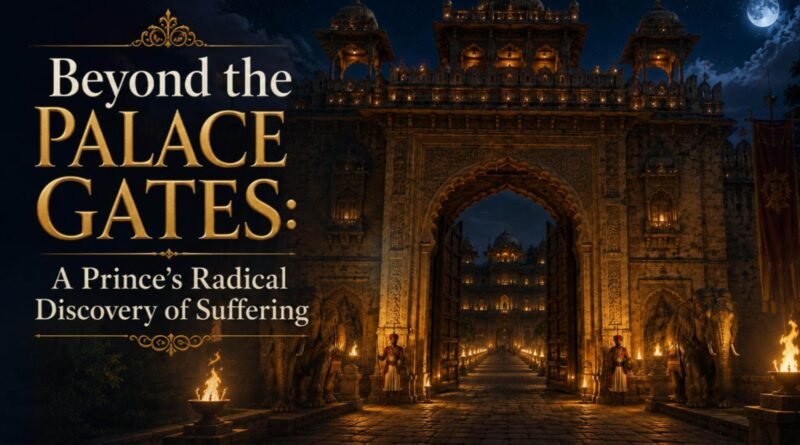
Beyond the Palace Gates: A Prince’s Radical Discovery of Suffering
By Sumati Bajracharya
We can have a comfortable life and still feel that something is missing. A good job, a beautiful home, financial security, and people who care about us do not necessarily quiet the deeper questions. Sometimes, in the middle of a life that looks perfectly fine from the outside, a quiet uneasiness remains.
Prince Siddhartha Gautama encountered that uneasiness in a much more dramatic way. He had luxury, privilege, and protection. Yet once he came face to face with aging, illness, and death, he could no longer look away. The palace could keep those realities out of sight for some time. But, it could not keep them from being true.
When Comfort Could No Longer Hide Reality
According to traditional Buddhist biographies, King Suddhodana tried to protect his son from anything that might disturb his happiness. Siddhartha was surrounded by luxury and, as far as possible, shielded from suffering and unpleasantness.
But beyond the palace, he encountered four sights that would change the direction of his life.
First, he saw an old man—his hair white, his body bent, leaning on a staff. When Siddhartha asked what had happened, his charioteer explained that the man was suffering from old age and that everyone, including Siddhartha himself, would eventually grow old.
Then he saw someone overcome by severe illness. Next came a funeral procession. A body was being carried for cremation while grieving relatives followed behind.
The three encounters began to unsettle him. These were not isolated misfortunes belonging to other people. The old man was showing him what his own body would one day become. The sick person showed him what could happen to his own body. The funeral showed him where every life eventually leads.
Aging, sickness, and death were not exceptions to life. They were part of life itself. What, then, was the meaning of all the pleasure and security he enjoyed if none of it could ultimately protect him—or anyone else—from these realities?
Then came the fourth sight: a wandering renunciant, or samaṇa. Unlike those overwhelmed by sickness, loss, and death, this person appeared peaceful and composed. According to the traditional account, Siddhartha saw in him something he had never encountered within the palace: the possibility of seeking freedom not by controlling the world, but by understanding and transforming the mind.
The Four Sights belong primarily to the traditional biographies of the Buddha. Yet the deeper question behind them is echoed powerfully in the Buddha’s own account of his quest preserved in the Ariyapariyesanā Sutta (MN 26).
The Question Behind the Sights
Looking back on his life before awakening, the Buddha described a realization that had begun to trouble him deeply: if he himself was subject to birth, aging, sickness, death, sorrow, and defilement, why should he seek happiness in things that were subject to those same conditions?
It is a simple question, but it changes everything. Siddhartha was no longer asking, How can I make life more comfortable? He was asking something much harder: Is there a freedom that is not destroyed by aging, sickness, death, and loss?
That question eventually led him beyond the palace. Traditional accounts describe him leaving behind his royal life, his wife Yashodhara, and his young son Rahula to pursue the truth. This can easily be reduced to a story about a prince abandoning his family, but that misses the seriousness of what he was seeking. He wanted to know whether suffering could actually be overcome.
He was looking for an answer that would apply not only to himself, but to human life.
The Failure of Extremes
Siddhartha spent years searching. He studied with accomplished meditation teachers and mastered profound states of concentration. Yet he recognized that these attainments did not provide the final freedom he sought.
He then turned toward severe ascetic practices. In his own account in the Mahāsīhanāda Sutta (MN 36), he describes subjecting himself to extreme forms of self-mortification until his body became profoundly emaciated.
But suffering the body more intensely did not free the mind. Eventually, Siddhartha understood that neither indulgence in sensual pleasure nor destruction of the body could provide the answer. He abandoned extreme asceticism, took nourishment, regained his strength, and returned to meditation.
This was an important turning point. The answer, he realized, could not lie at either extreme.
The path he discovered became known as the Middle Way—a way that avoids both sensual indulgence and self-mortification.
From Seeking to Discovery
Then, beneath the Bodhi tree, Siddhartha Gautama awakened.
What he discovered was not simply a philosophy to believe. It was something to be understood and directly realized. The structure of that discovery became known as the Four Noble Truths:
Dukkha — conditioned existence is marked by suffering, unsatisfactoriness, and instability.
Samudaya — suffering has an origin, most fundamentally craving (taṇhā).
Nirodha — suffering can cease through the cessation of its causes.
Magga — there is a path leading to that cessation.
The Buddha was not simply saying, Life is difficult. He was pointing to something much more precise: suffering does not arise randomly. It has conditions. And if those conditions can be understood, they can also be abandoned.
That changed the question completely. Suffering was no longer only something to endure or explain. It was something that could be investigated, understood, and ultimately brought to an end.
The Path Was Not a Theory
The Buddha did not stop with insight. He taught a way of practice: the Noble Eightfold Path.
It consists of Right View, Right Resolve, Right Speech, Right Action, Right Livelihood, Right Effort, Right Mindfulness, and Right Concentration. These eight factors can be understood through three interconnected dimensions of practice: wisdom, ethical conduct, and mental cultivation.
But the Path is not only a list of teachings. It asks practical questions. How do we speak to one another? What intentions guide our decisions? How do we earn a living? What happens in our minds when anger, jealousy, fear, or craving arise? Can we notice these states before they take over?
Right View asks us to see reality more clearly, including the consequences of our actions. Right Resolve examines the intentions behind what we do. Right Speech, Right Action, and Right Livelihood bring non-harm into our relationships and our work. Right Effort, Right Mindfulness, and Right Concentration cultivate the mind so that understanding can deepen.
In this way, the Buddha’s discovery became a way of life. It was not merely something to admire. It was something to practice.
What Was So Radical About It?
Perhaps the most radical part of the Buddha’s discovery was that he did not promise to make the world free from aging, sickness, death, or loss. He did not discover a way to make the body immortal or the world permanently pleasant. He saw that the world cannot be made permanently secure simply because we want it to be. What must change is not merely our attitude toward suffering, but our relationship to the craving, clinging, and ignorance that give rise to it.
This is an important distinction. Buddhism is not simply asking us to become better at tolerating an unpleasant life. The Buddha was pointing to something deeper: if the causes of suffering can be abandoned, then freedom is possible.
That is why the renunciant in the traditional story mattered so much to Siddhartha. The renunciant represented not an escape from the realities of life, but another possibility—a different way of living with them.
Beyond the Palace Gates
More than twenty-six centuries later, the problem Siddhartha encountered has not disappeared.
Our palaces simply look different now. They may be comfortable homes, bank accounts, carefully managed social-media profiles, streaming screens, busy schedules, or phones we reach for whenever silence becomes uncomfortable. We have more ways than ever to keep ourselves occupied and distracted.
Yet aging still comes. Sickness still comes. Loss still comes. Death still comes. And beneath all our efforts to secure happiness lies the same difficult question: If everything around us is changing, where can lasting freedom actually be found?
The Buddha’s answer was not another luxury to acquire, another belief to accept, or another distraction from reality. It was a path. When we are surrounded by noise, can we practice Right Mindfulness? When everyone has an opinion to broadcast, can we practice Right Speech? When success constantly invites us to want more, can we practice Right Resolve? And when circumstances do not unfold according to our wishes, can we notice the craving and resistance arising in our own minds?
These questions bring the Buddha’s journey much closer to home. The traditional story tells us that the Prince walked beyond the palace gates looking for an answer to suffering. We do not have to leave our homes or abandon our families to begin asking the same questions.
Our own “palace” may be made of comfort, fear, attachment, ambition, distraction, or habit. Its walls may be invisible, but they can be just as effective at keeping difficult truths out of sight. Perhaps the real challenge is not simply understanding what the Buddha discovered. It is having the courage to look beyond the gates of our own carefully constructed lives—and to begin the practice of freedom.