Is There a Soul?
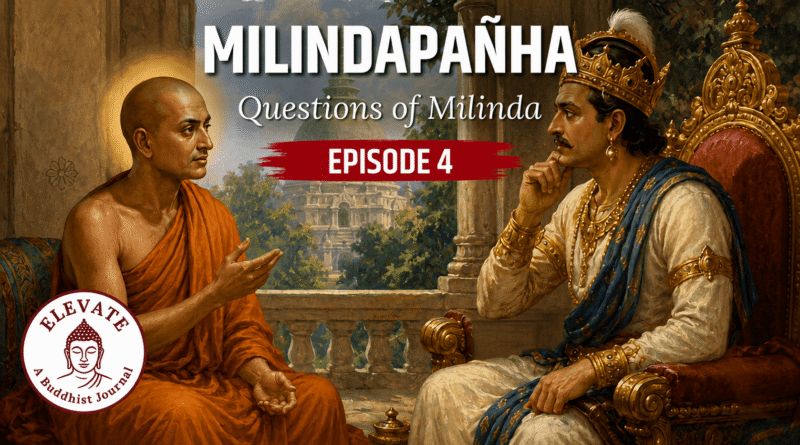
Milindapañha, Episode 4
When someone dies, what actually leaves the body?
Many people answer without hesitation:
“The soul.”
Across cultures and religions, people have long believed that an invisible soul lives inside the body, entering at birth and departing at death.
But does Buddhism teach the same?
King Milinda asked a question that led Nāgasena to challenge this ancient belief in a surprising way.
After leaving one of his discussions with Nāgasena, one of the king’s companions, Anantakāya, continued thinking about the monk’s teaching.
As they walked together, he asked,
“When people call you Nāgasena, what is that Nāgasena?”
Then he offered his own answer.
“It is the soul—the inner breath that comes and goes.”
Nāgasena replied with another question.
“If the breath leaves the body and never returns, would that person still be alive?”
“Certainly not,” Anantakāya answered.
Nāgasena then asked,
“When trumpeters blow their trumpets, does the breath return to them after they blow?”
“No,” he replied.
“Then why don’t they die?”
Anantakāya had no answer.
Nāgasena explained:
“The breath itself is not a soul. Inhalation and exhalation are simply natural functions of the body.”
What we call “life” cannot be reduced to breath alone.
Nor does Buddhism teach that there is an eternal soul hidden within it.
Nāgasena was not saying that life doesn’t exist.
He was explaining that life is a process—not a permanent entity.
Breathing, feeling, thinking, remembering, and being conscious all arise because of many conditions working together.
When those conditions change, the experience changes.
There is no unchanging self directing everything from behind the scenes.
Just as a flame depends on fuel, oxygen, and heat, our existence depends on countless changing conditions.
Remove the conditions, and the process ends.
Nothing permanent needs to leave.
Even today, we often speak as though there is a tiny “me” sitting somewhere inside the body, watching life unfold.
We say,
“My mind…”
“My body…”
“My thoughts…”
as though there is another owner behind them.
But when we carefully observe our experience, where is this permanent owner?
Thoughts come and go.
Emotions arise and disappear.
The body changes every moment.
Everything is changing.
The Buddha encouraged us not to accept this teaching merely as philosophy, but to observe it directly through mindfulness.
Buddhism does not deny experience.
It simply invites us to look carefully and ask:
Is there anything in our experience that remains permanent, independent, and unchanging?
The more deeply we observe, the more we discover that everything arises because of causes and conditions.
Understanding this loosens our attachment to the idea of “I” and “mine.”
And as attachment weakens, so does suffering.
The next time you notice your thoughts, emotions, or even your breathing, pause for a moment and ask:
Are these truly “me”… or are they simply changing processes unfolding according to causes and conditions?
That simple observation can open the door to profound wisdom.
In our next episode, King Milinda asks another practical question:
Why do people become monks?
Nāgasena’s answer reveals that while many enter the monastic life for worldly reasons, the true purpose of the Buddhist path is far deeper than most people imagine.
Until then, may your discussions be guided not by the desire to win, but by the desire to understand.