Milindapañha, Episode3: Winning an Argument or Finding the Truth?
Have you ever noticed that many arguments today have very little to do with discovering the truth?
Whether it is politics, religion, sports, or even family disagreements, people often enter a conversation with only one goal:
To win.
They interrupt.
They defend themselves.
They refuse to admit they might be wrong.
And when the argument ends, no one has learned anything.
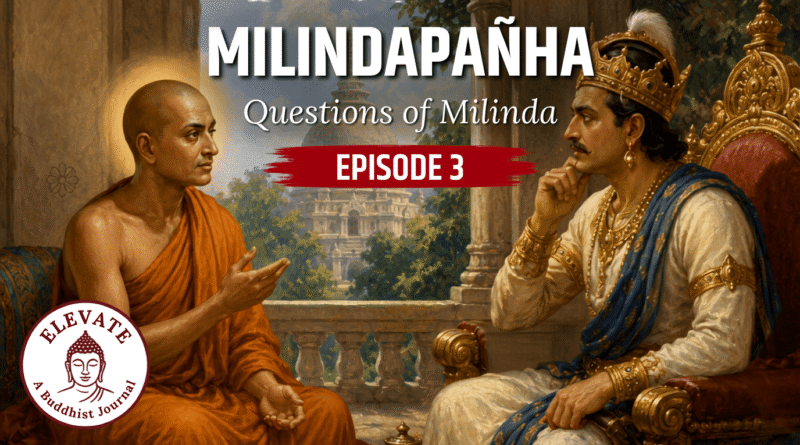
More than two thousand years ago, King Milinda asked the Buddhist monk Nāgasena a question about discussion.
His answer offers a lesson our world desperately needs today.
King Milinda asked:
“Venerable Nāgasena, will you discuss with me?”
Nāgasena replied:
“If Your Majesty discusses as a scholar, yes. But if you discuss as a king, no.”
The king was intrigued.
“What is the difference?”
Nāgasena explained that when scholars discuss, they examine a subject together. They question, explain, and clarify. And if one is shown to be mistaken, he admits it without anger.
But when kings discuss, they hold firmly to their own opinions. Disagreement becomes a challenge to their authority.
King Milinda reflected and replied:
“Very well. I shall discuss as a scholar.”
At first, this seems to be a conversation about kings and scholars.
But Nāgasena is pointing toward something much deeper.
Every one of us has a little king inside.
When someone disagrees with us, do we listen—or immediately prepare our defense?
Do we ask, “What is true?”
Or do we ask, “How can I prove that I am right?”
A true scholar is not someone who knows everything.
A true scholar is someone who loves truth more than pride.
That requires humility—the willingness to question our assumptions and even say:
“I may be mistaken.”
That is not weakness.
It is the beginning of wisdom.
Look at social media today. A simple difference of opinion can quickly become an argument. People defend their positions, attack opposing views, and sometimes insult complete strangers.
Why?
Because the conversation has stopped being a search for truth.
It has become a contest of identity.
The dialogue between Milinda and Nāgasena was different.
King Milinda asked difficult questions. Nāgasena responded patiently. Neither was trying to defeat the other.
They were searching for wisdom together.
So before entering our next difficult conversation, perhaps we should ask ourselves:
“What do I want more—to be right, or to understand?”
Imagine if families asked this question.
Imagine if political leaders did.
Imagine if religious communities did.
Conflict would not disappear.
But wisdom could grow.
Nāgasena reminds us:
Truth cannot be discovered by pride.
A mind obsessed with victory cannot clearly see reality.
Wisdom begins when we become willing to listen, question, and reconsider.
Because the moment we say,
“I may be wrong,”
we open the door to learning.
Perhaps that is the real difference between discussing like a king and discussing like a scholar.
A king asks:
“How can I win?”
A scholar asks:
“What is true?”
In our next episode, King Milinda asks one of humanity’s oldest questions:
“Is there a soul within us?”
Nāgasena’s answer will challenge one of our deepest assumptions and lead us into the Buddha’s profound teaching of non-self.
Until then, may your discussions be guided not by the desire to win, but by the desire to understand.
May you be well, peaceful, and wise.