
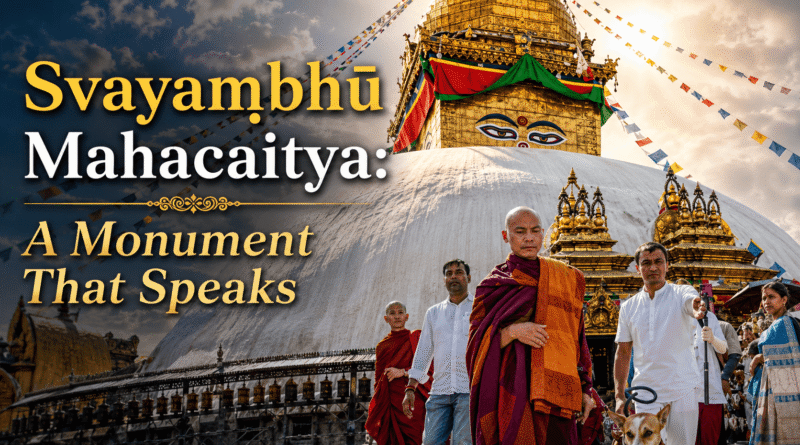
Svayaṃbhū Mahacaitya: A Monument That Speaks
How Nepal’s Greatest Buddhist Monument Became a Three-Dimensional Mandala
Every day, thousands of pilgrims climb the ancient hill of Svayaṃbhū in Kathmandu. Some come to light butter lamps, their flickering flames symbolizing the dispelling of ignorance. Others slowly circumambulate the great white dome while turning prayer wheels and softly reciting Buddhist verses. Many pause beneath the gilded Harmikā, gazing into the iconic all-seeing eyes that look serenely toward the four cardinal directions. To countless devotees, the Svayaṃbhū Mahacaitya is a place of profound faith and spiritual refuge. To visitors, it is one of Nepal’s most recognizable landmarks, admired for its antiquity, beauty, and commanding view over the Kathmandu Valley. As one of the seven monument zones of the UNESCO World Heritage Site of the Kathmandu Valley, it also stands among the world’s most important cultural and religious treasures.
Yet the Svayaṃbhū Mahacaitya is far more than an ancient monument or a destination for pilgrimage. Every brick, proportion, architectural element, and sacred image was carefully conceived to embody the Buddha’s teachings. Long before a visitor learns its history, the monument itself begins to communicate. Its architecture speaks—not through words, but through form, proportion, symbolism, and the sacred language of space.
This silent language did not emerge by chance. The Svayaṃbhū Mahacaitya that stands today is the culmination of more than a thousand years of religious reflection, artistic innovation, architectural refinement, and philosophical development.
Although caityas originated as simple earthen mounds enshrining the relics of the Buddha, they gradually evolved into one of the most sophisticated symbolic structures in the Buddhist world. With each generation, new layers of meaning were incorporated into their design, transforming them from memorial structures into comprehensive visual expressions of Buddhist cosmology and the path toward enlightenment.
However, the Svayaṃbhū Mahacaitya introduces a concept that challenges our standard Western view of architecture. As its name suggests, it is believed to be spontaneously manifested rather than built by human hands—Svayaṃbhū meaning ‘self-arising’ or ‘self-existent’ in Sanskrit. According to Buddhist sacred tradition, long before human settlements flourished in the Kathmandu Valley, the region was a vast primordial lake. At its center appeared a magnificent lotus radiating divine brilliance. When the waters receded, the lotus gave rise to the sacred hill that would become the home of the Svayaṃbhū Mahācaitya.
For those familiar with the Walk for Peace, the concept of “self-arising” carries a profound parallel. In Buddhist psychology, peace is not something imposed upon us from the outside. Like Svayaṃbhū itself, true peace is an innate quality of the mind—already present within, waiting to be revealed through the journey of awakening.
The Mahācaitya was not created simply as a monument to something beyond ourselves; it stands as a mirror reflecting the unconditioned peace, wisdom, and compassion that lie within every human heart.
To fully appreciate the Svayaṃbhū Mahācaitya, one must look beyond its outward beauty and recognize the profound symbolism embedded within its design. Its dome is not merely an elegant architectural form, and its towering spire is not simply an ornamental pinnacle. The Buddha images, the iconic all-seeing eyes adorning the Harmikā, the thirteen ascending rings (chhatras) representing stages of spiritual attainment, and the sacred ornaments are not merely aesthetic additions. Together, they form a unified symbolic language through which Buddhist philosophy, cosmology, and the path toward awakening are expressed in architectural form.
The evolution of the Mahacaitya also reflects the broader intellectual history of Buddhism itself. As Buddhist thought developed—from the early tradition of venerating the Buddha’s relics to the rich symbolic traditions of the Mahāyāna and Vajrayāna—its sacred architecture evolved alongside it. It came to embody the Buddha, the Dhamma, the enlightened universe, and ultimately the spiritual journey itself. Architecture had become an expression of Dhamma. Nowhere is this transformation more fully realized than at Svayaṃbhū.
While many Buddhist monuments across Asia reflect this symbolic tradition, the Svayaṃbhū Mahācaitya preserves one of its most profound and sophisticated expressions. It exists simultaneously as a place of devotion, a masterpiece of sacred architecture, a living testament to Buddhist history and heritage, and a three-dimensional mandala through which centuries of philosophical insight, artistic creativity, and ritual practice are expressed.
The story of the Svayaṃbhū Mahacaitya is therefore not simply the history of a monument. It is the story of how generations of Buddhist thinkers, architects, artists, and practitioners gradually transformed stone, brick, wood, and gilded copper into one of humanity’s most profound expressions of the enlightened mind.
Therefore, the true significance of the Svayaṃbhū Mahācaitya emerges only when we learn to understand its silent language. Its meaning is not contained in written words, but revealed through brick, stone, timber, and gilded copper. Through its forms, proportions, and symbols, the monument guides the observer from the physical realm toward the realization of awakening.
The journey into this symbolic world begins at the very foundation of the Mahācaitya itself.
The Foundation
According to medieval architectural treatises, the construction of a Mahacaitya did not begin with bricks or stone but with geometry. Before a single course of masonry was laid, the building site was carefully divided into a perfectly proportioned square grid. This geometric plan established harmony, balance, and order—the essential conditions upon which the entire monument would rest. Far from being a matter of engineering convenience, the square represented stability, equilibrium, and the ordered nature of the cosmos itself.
From this carefully measured foundation emerged every subsequent architectural element. The monument’s proportions were governed by precise mathematical relationships, ensuring that each component formed part of a coherent symbolic whole. Medieval Buddhist architects understood that physical harmony reflected spiritual harmony. Correct proportion was therefore not merely aesthetically pleasing; it was itself an expression of Dhamma.
The Dome
Rising above the base is the great white dome, known in Sanskrit as the aṇḍa, literally meaning “egg.” Although simple in appearance, this hemispherical form carries extraordinary symbolic depth. It represents both the universe itself and the limitless nature of the awakened mind. Like an egg containing the potential for new life, the dome signifies the spiritual awakening that lies dormant within every sentient being.
As the Buddhist philosophy evolved, the dome came to embody far more than a physical container. It became a symbol of the Buddha’s enlightened presence and the boundless wisdom that transcends birth and death. Its smooth, uninterrupted curve itself is meaningful. Unlike buildings defined by sharp corners and rigid divisions, the hemisphere suggests wholeness, completeness, and the indivisible nature of ultimate reality. The dome invites the mind to contemplate unity rather than separation.
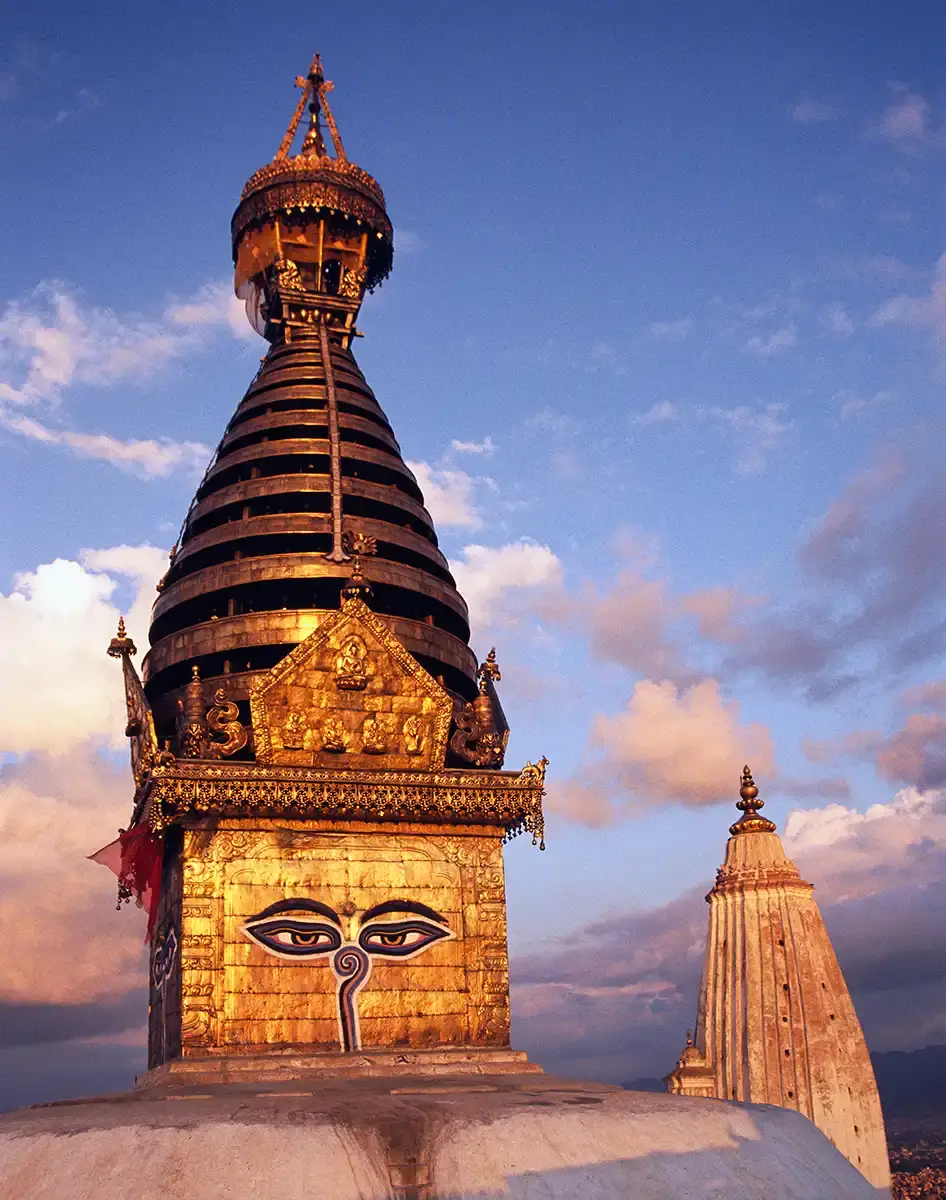
The Yasti: The Axis of the Universe
Piercing the center of the dome is the Yasti, the central pillar that forms the monument’s spiritual axis. Medieval texts often identify this pillar with the Indrakīla—the cosmic stake that anchors the universe and links the earthly realm with higher planes of existence.
Its symbolism is profound. Rising vertically from the heart of the dome, the Yasti unites earth and heaven, reminding devotees that enlightenment is not an escape from the world but a path that transcends it. Just as the axis gives the monument its strength and balance, wisdom provides the foundation upon which the path to liberation rests.
For pilgrims circumambulating the Mahacaitya, the unseen pillar silently proclaims that the path to awakening is grounded in stability, discipline, and unwavering practice.
The Harmikā: The Realm of Awakening
Resting upon the dome is the cubical Harmikā, one of the monument’s most recognizable features. In Buddhist architectural symbolism, it represents the realm of enlightenment—the domain beyond ignorance, craving, and suffering.
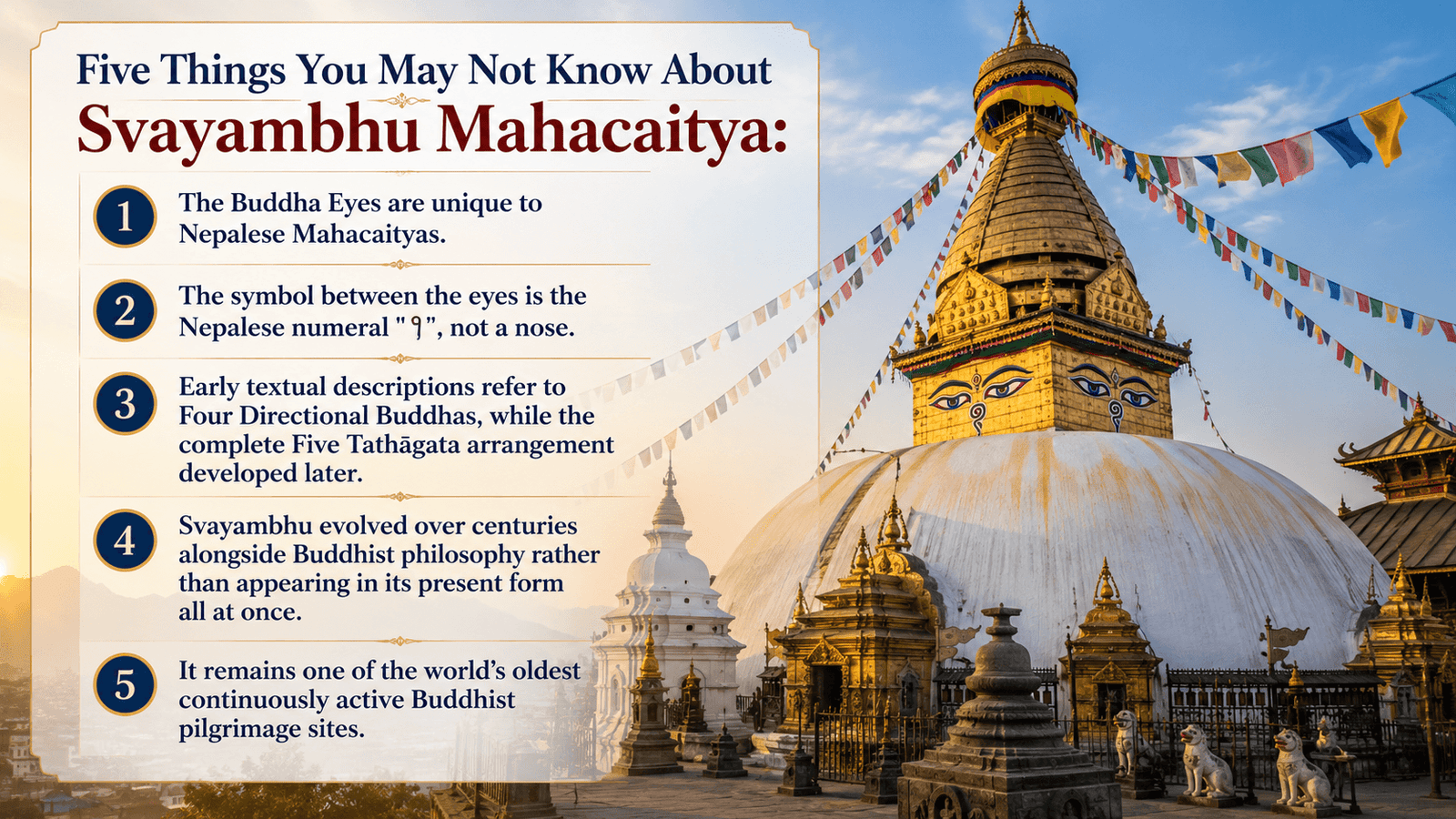
At Svayaṃbhū, the Harmikā bears the famous all-seeing eyes that have become synonymous with Nepalese Buddhism. Looking serenely toward the four cardinal directions, these eyes remind pilgrims that the wisdom of the Buddha extends universally, embracing all beings without distinction. Rather than suggesting divine surveillance, they symbolize perfect awareness—seeing reality exactly as it is.
Between the eyes appears the distinctive Nepalese symbol often mistaken by visitors for a nose. In fact, it is the Nepalese character for the numeral one, signifying the unity of existence and the path towards liberation. Together, these elements transform the Harmikā into a visual expression of enlightened perception.
The Ascending Chhatras: Stages of Spiritual Realization
Above the Harmikā rises the elegant spire composed of thirteen ascending rings of chhatras (umbrellas). To casual observers, these elements may appear merely ornamental, but Buddhist architectural traditions emphasize that their number was never arbitrary. Architectural manuals prescribed different numbers of umbrella tiers for different classes of caityas, according to the spiritual significance of the beings or principles they commemorated. A Mahācaitya associated with a Samyaksaṃbuddha or Vajradhara traditionally bore thirteen tiers, while other classes of monuments followed different prescriptions.
Within the Nepalese Buddhist tradition, these ascending levels have long been understood as symbols of progressive spiritual realization. Rising one above another toward the open sky, they evoke the gradual journey from ignorance toward complete awakening. The thirteen rings of the Svayaṃbhū Mahācaitya are traditionally interpreted as representing the successive stages of spiritual development that a Bodhisattva traverses on the path toward full Buddhahood.
As the chhatras ascend toward the heavens, they symbolize the refinement of wisdom, compassion, and awareness through continued practice. The upward movement of the spire reflects the inner journey of the practitioner—from the limitations of ordinary perception toward the boundless realization of awakening.
At the summit rests the gilded pinnacle, crowning the entire structure. Visually, it draws the eye upward; spiritually, it points beyond the material world toward the highest aspiration of Buddhist practice—the realization of enlightenment.
The Emergence of the Directional Buddhas and the Five Tathāgatas
The architectural evolution of the Mahācaitya did not end with geometry and symbolism. As Buddhist philosophy evolved, so did its sacred imagery. The monument gradually transformed from a symbolic representation of the Buddha into a visual expression of the enlightened cosmos.
One of the most significant developments was the incorporation of Buddha images into the structure itself. Today, the majestic Buddha figures facing the four cardinal directions appear inseparable from the identity of Svayaṃbhū. Yet their presence reflects a long historical evolution.
The earliest Buddhist stūpas were fundamentally aniconic. Rather than portraying the Buddha in human form, they honored him through relics and symbols such as the Bodhi tree, Dharma wheel, empty throne, and the stūpa itself. Over time, however, Buddhist devotional practices embraced sacred imagery as a means of contemplation and as expressions of the Buddha’s awakened qualities.
The changing imagery of the Mahācaitya also preserves a record of Buddhism’s own intellectual journey. This transformation is reflected in early textual traditions. The Bṛhat Svayaṃbhū Purāṇa describes Svayaṃbhū as containing the Four Directional Buddhas together with the Four Tārās, but it does not mention Vairocana Tathāgata as the central Buddha or Vajradhātvīśvarī. This suggests that the fully developed five-Buddha iconographic system had not yet been established when the text was composed.
A similar pattern appears in the Suvarṇaprabhāsa Sūtra, an important Mahāyāna scripture that predates the Guhyasamāja Tantra. It describes four principal Buddhas rather than the later system of Five Tathāgatas and identifies the northern Buddha as Dundubhisvara rather than Amoghasiddhi. These variations reveal that Buddhist cosmology, like the Mahācaitya itself, developed gradually through centuries of reflection, interpretation, and practice.
The decisive transformation emerged with the Guhyasamāja Tantra, which presented the complete system of the Five Tathāgatas and their associated Tārās. Each Buddha came to represent a distinct direction and aspect of awakened wisdom, while together they expressed the unity of Buddhahood. The Mahācaitya thus became a three-dimensional expression of Vajrayāna cosmology—a sacred space where devotees could contemplate wisdom, compassion, meditation, and ultimate reality.
This iconographic development profoundly influenced Buddhist architecture throughout the Kathmandu Valley. Monuments such as Mahābouddha, Śrīgha Vihāra, Dhanyadyaḥ Caitya, Chilancho Caitya, and Boudhanath incorporated images of the Directional Buddhas and associated deities into their designs.
Yet Svayaṃbhū remains exceptional. While many later caityas adopted elements of its symbolic language, few preserved its complete iconographic program. Most present the Four Directional Buddhas, whereas Svayaṃbhū reflects the mature synthesis of Nepalese Vajrayāna Buddhism. The monument therefore serves not only as an ancient shrine but also as a living historical record of Buddhist philosophical development in the Kathmandu Valley.
The evolution continued beyond this stage. Later works such as the Sādhanamālā further refined the Five Tathāgata system, assigning each Buddha a distinct color, direction, mudrā, attribute, and spiritual function. These developments demonstrate that the Mahācaitya was never a static monument frozen in time. Like Buddhism itself, it remained a living tradition, continually enriched by new insights, rituals, and artistic expressions.
Seen in this historical light, the Buddha images of Svayaṃbhū are far more than devotional sculptures. They preserve centuries of intellectual and spiritual evolution in visible form. Each image represents another chapter in Buddhism’s unfolding understanding of awakening.
The Mahācaitya therefore tells two intertwined stories: the evolution of sacred architecture and the evolution of Buddhist thought. Together, they transform Svayaṃbhū into something extraordinary—not merely a place where the Buddha is remembered, but a living mandala where centuries of Buddhist wisdom, philosophy, and aspiration are expressed in enduring architectural form.
Editor’s Note
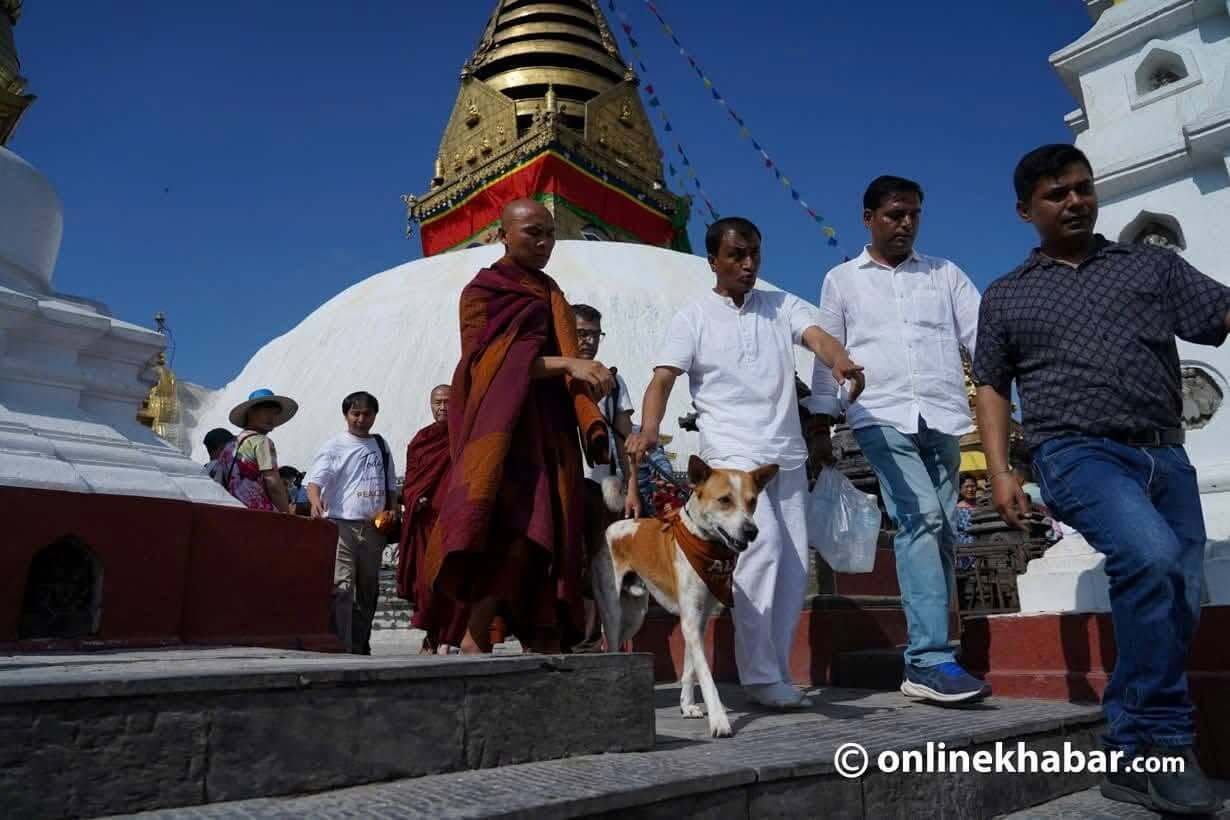
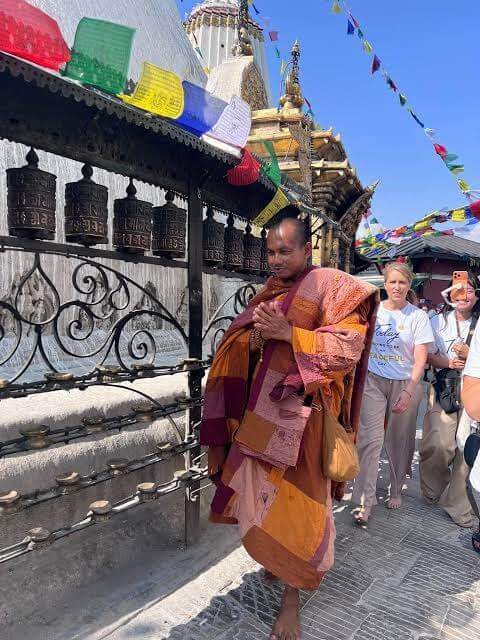
When Venerable Bhikkhu Pannakara visited Kathmandu in June, one of the places he visited was the sacred Svayaṃbhū Mahācaitya, one of Nepal’s most revered Buddhist monuments and a symbol of Buddhist heritage for more than a millennium. The images and reflections shared from his visit through the Walk for Peace community generated tremendous interest among followers around the world. Many expressed curiosity about the history, symbolism, and deeper meaning of this extraordinary monument that stands atop the ancient hill overlooking the Kathmandu Valley.
This article draws upon the work of Vajrayāna teacher Sumati Bajracharya and was inspired by the widespread interest following Venerable Bhikkhu Pannakara’s visit to the sacred Svayaṃbhū Mahācaitya. It seeks to present Svayaṃbhū not merely as one of Nepal’s most revered Buddhist monuments, but as a living architectural expression of Buddhist philosophy and the path to awakening. Photo courtesy: onlinekhabar.com

Inspiring journal.