
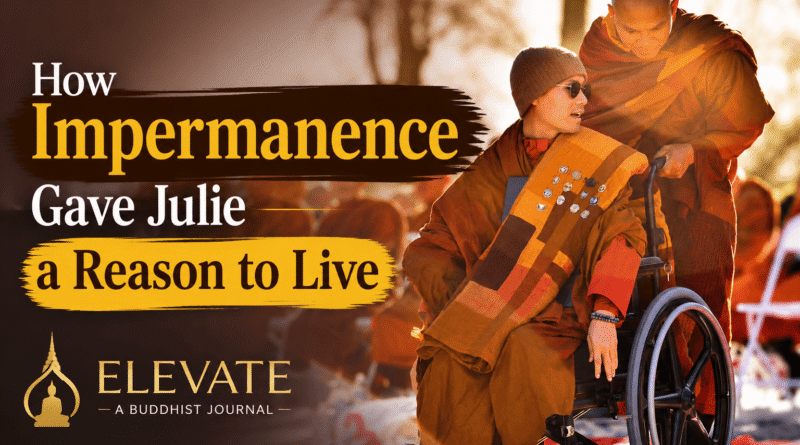
How Impermanence Gave Julie a Reason to Live
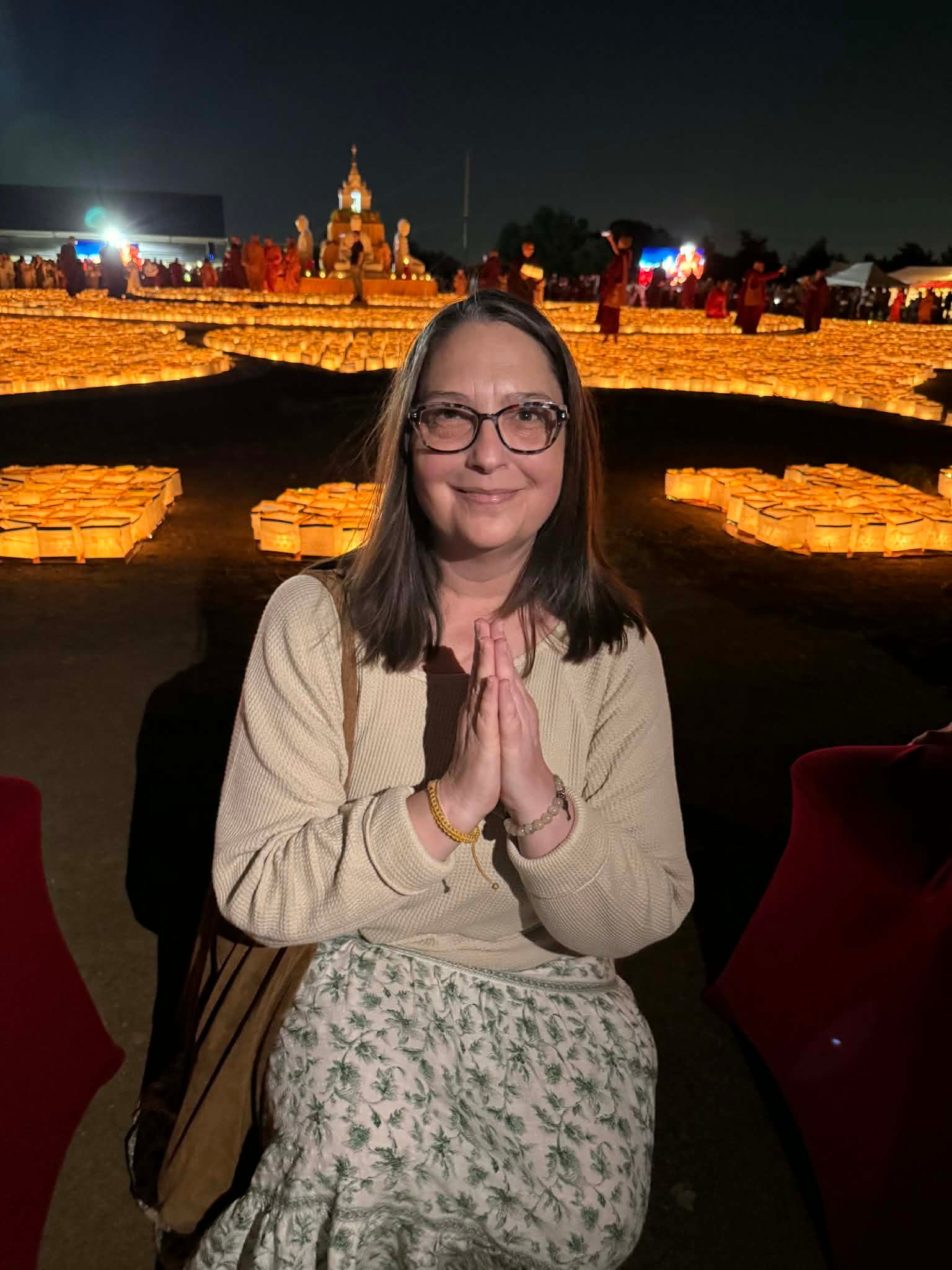
Julie was born with a blank spiritual slate. Growing up in the Bible Belt of Southern Georgia, her spiritual landscape was curiously empty—no talk of God, no mention of an afterlife, only the festive figures of Santa Claus and the Easter Bunny.
The darkness first arrived in her twenties in the wake of a breakup. Julie found herself driving her car, over the “Spaghetti Junction” in Atlanta. She felt an urge to drive off the edge and “turn the lights off” on an existence that felt too heavy to carry. Only the fear of hurting others changed her mind. Then for decades, through a blindsiding divorce, exhaustion of being a single parent, and a diagnosis of melanoma while also taking care of a very sick friend, that “switch” remained a haunting temptation.
It was only through a serendipitous encounter with a group of walking monks and the ancient, wisdom of impermanence that Julie found the strength to trade her desire for an end, for a reason to begin.
Choosing Kindness Over Broken Dogma
Julie’s spiritual journey was nearly derailed by an institution meant to offer sanctuary. A friend suggested Julie seek spiritual guidance at a local church, and she agreed since she still felt depressed. Unfortunately, she was sexually assaulted by a man at the church that everyone trusted. She came forward and the church “forgivingly” protected him to keep his position, leaving Julie to navigate the trauma alone.
Disillusioned by this hypocrisy, Julie went for a walk in the woods and asked the universe to “show her a better way.” She left the woods with the thought that it “felt good to be good” and “felt bad to be bad.” At that point she decided to let nature be her temple, and for kindness to be her religion.
By centering her life on kindness rather than institutional permission, she regained her agency. She proved that morality doesn’t require a pulpit—it only requires a heart willing to stay soft in a hard world.
When the “End” is the Only Hope: Embracing the Lifeline of Impermanence
Most people view impermanence with a sense of dread. But for someone who has thoughts of suicide, the idea that nothing lasts forever is not a threat—it is a lifeline.
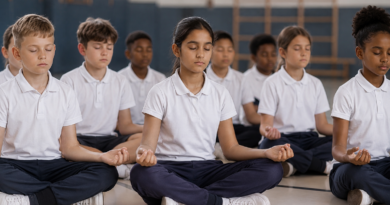
At age 40, Julie found herself briefly attending a Tibetan Monastery to learn about meditation to help her through stressful times. It was there that she learned something very valuable. A monk spoke of how nothing is permanent.
Julie realized that if nothing is permanent, then the pain she was feeling is also impermanent. She understood that if she could just “hold on” a little while longer, the feeling would eventually fade.
This is the radical shift: for those in suffering, the “end of a state” is the definition of hope. By accepting that the darkness had an expiration date, she found the space to breathe.
Joy is not the absence of suffering
In late 2025, Julie received a melanoma diagnosis, with no idea what her outcome would be. It was then that she saw a news report about a Georgia monk named Maha Dam Phommasan, who had been hit by a car while walking for peace in Texas. This made her think of the monastery she visited 17 years ago. She began following the “Walk for Peace,” watching videos of monks walking across the country in ice, rain, and scorching heat.
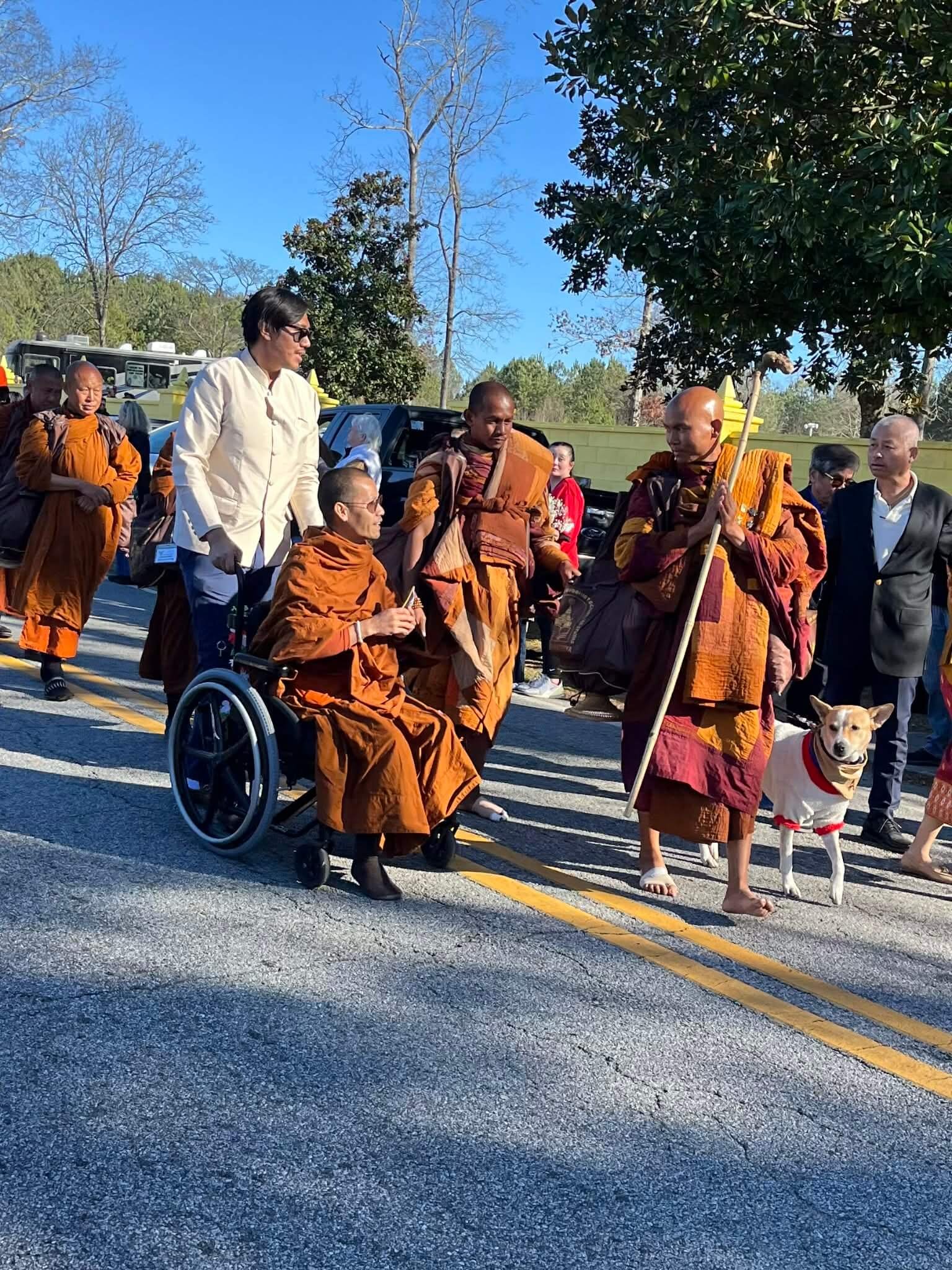
She was amazed by what she saw. These monks had feet taped up to cover their blisters and wounds, yet they wore “the hugest smiles” she had ever seen. The most transformative moment occurred when she saw Maha Dam in his wheelchairat Wat Lao Buddha Khanti on January 1, as the team was about to say their goodbyes. Her initial reaction was one of sadness that Maha Dam had lost his leg and cannot walk with them anymore. But as she watched the other monks approach him, he did not seem sad at all. Surprisingly he had the brightest smile she had ever seen, and her sadness dissolved into pure awe as she watched each monk kneel before him, holding his hands with a reverence and joy that lit up the entire street.
“I have never seen this much love in my entire 56 years. I want to live like that. I want to feel like that.”This is when she decided she was changing her life from that day forward. She was going to listen to all Venerable Bhikkhu Pannakara’s talks, she was going to meet Maha Dam and seek his guidance, and she was going to learn to be able to live in peace like they did.
Joy is not the absence of suffering. It is a state of being that exists alongside it. Watching the monks with taped feet and broken bodies radiate pure love taught Julie that her own “bad deck of cards” did not have to be the end of her joy.
Trading the “Bad Deck of Cards”
For years, Julie carried a resentment toward the universe. She felt “mad at God” for the cards she had been dealt—The question “Why me?” was a constant, painful refrain.
Her perspective shifted through the teachings of the Venerable monks. They taught that karma isn’t a “one-life” justice system, but a journey spanning thousands of lifetimes. This transition to a “long-game” perspective removed the victimhood. Rather than seeing her suffering as meaningless or unfair, Julie found comfort in viewing life through the broader Buddhist perspective of karma and rebirth. It shifted her attention away from “Why me?” toward “How do I respond now to try to remove suffering and live more peacefully?”
This shift even allowed her to process her struggle with the monk’s teaching on “honoring parents”—a difficult concept for someone who grew up in a home marked by strained relationships. Through multiple Dhamma talks, something finally “clicked” and she finally saw things differently. By viewing these relationships as part of an ancient cycle of lifetimes, she moved from resentment to an understanding that her parents were also dealing with their own karma with their own cycle of suffering. This became her motivation to stop fighting the “deck” and start seeking peace in all aspects of her life.
The Miracle of the Craft Room
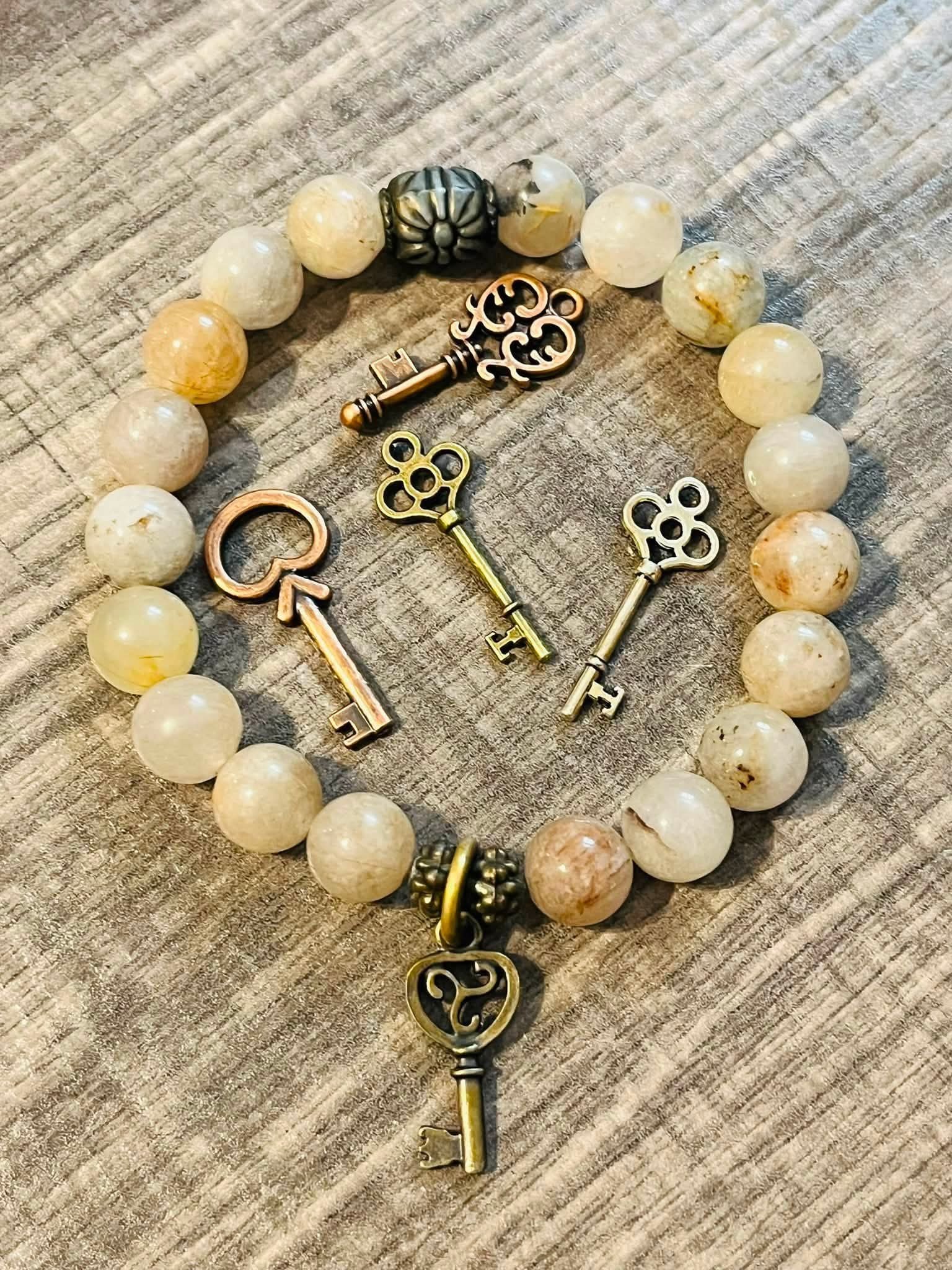
The final lesson came through a moment of pure serendipity. Julie had been wearing a beaded bracelet that she got on her last day visiting Drepung Loseling, for the last 17 years. The day after she received a new “blessing bracelet” from the Walk for Peace on January 1, the old, beaded bracelet finally gave way. The beads scattered everywhere—a symbolic death of her old self to make room for the new. She wanted to keep those beads and create something new, so she pulled out her beading supplies while listening to a teaching by Venerable Bhikkhu Pannakara and she heard him say: “Mindfulness is the key. I am handing you the key, but now you must unlock your own box.”
At that exact moment, Julie looked down and saw a pile of key charms. “This wasn’t just a coincidence; it was a call to action.” It was a reminder that while teachers can provide the tools, the application is an individual responsibility.
Julie realized that she was no longer a victim waiting for the lights to go out. She was the one holding the key. She began making “key bracelets” to remind herself and others that we have the agency to unlock our own peace, one mindful breath at a time.
A Mindful Step Forward
Julie’s journey took her from the ledge of a highway interchange to the quiet joy of a craft room filled with keys. She moved from a “blank slate” to a life colored by the profound realization that while suffering is inevitable, staying in it is not. She now walks forward, no longer wanting to “flip the switch,” but choosing instead to light the world with the kindness she once sought.
Her story leaves us with a transformative challenge: If you viewed your current struggle not as a permanent tragedy, but as a temporary state in a journey of a thousand lifetimes, what key would you use to unlock your peace today?
By Elevate Editorial Desk. Based on a video message submitted to Elevate: A Buddhist Journal.
Julie’s story is so heartwarming. The fact that she recognized the talent that she could share to help others gain peace is so wonderful. I was in a similar situation. 3 suicide attempts, time in a psych ward and lots of medications, when all I needed was so find my own peace. I have followed them since Day 1 in October, but I love all the shared Dhamma talks, now. It is such a blessing!
Thank you for sharing your story Julie-the universe gives us many signs-many of which we fail to see-Im glad you were brave enough to unlock that box 🙂
What a beautiful story about Julie. I am happy to know more about this seeking woman. I am a seeker myself, with a back story for another day! How inspiring, thank you Julie!
Hello. What is the name and address of the Tibetan Monastery Julie Bell mentioned in the article where she attended a meditation course?