The Inimitable Roar: Understanding the Cūḷasīhanāda Sutta and the Path to True Liberation
The Majesty of the Lion’s Metaphor
In the Buddhist tradition, the “Lion’s Roar” (Sīhanāda) is far more than a poetic flourish; it is a strategic metaphor for the fearless proclamation of a supreme, unshakeable truth. The Buddha’s choice of the lion as a symbol was rooted in the animal’s highly disciplined and powerful behavior.
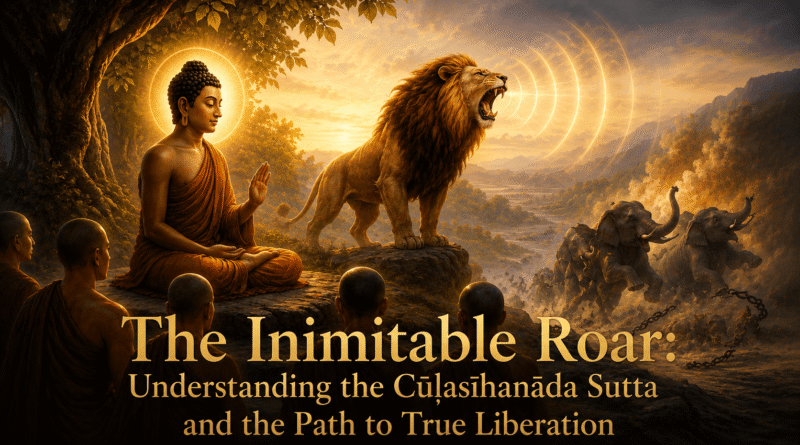
In a recent Rain Retreat discourse, Bhikkhu Sumedha of the International Mahabodhi Society in Garland, Texas, explained the traditional lion metaphor by describing how the great lion, regarded as the king of the jungle, typically resides in a mountain cave, establishing his presence before he acts. “Upon waking, he stretches, shakes his body, and surveys his domain. Before roaring, he looks around with a boundless heart of compassion for the little ones—small animals and birds—who might be physically overwhelmed by the sheer power of the sound,” he explained.
According to Bhikkhu Sumedha, “the lion typically runs three times in a circle with immense speed, and then he runs straight for his hunt”. When the lion finally roars, the impact is transformative. “Elephants, the strongest of the other beasts, break their post-ties and flee in terror, passing urine as they run”, he further noted. This traditional imagery is not merely a description of the wild animal; it is a profound symbolic representation of the Buddha’s compassion, confidence, and the transformative power of his Dhamma. The image of “frightened elephants” can, in this context, be understood symbolically as representing rival teachers of the Buddha’s era. Despite their claims to spiritual knowledge and attainment, they could not withstand the challenge posed by the Buddha’s profound insight into impermanence, suffering, and the absence of a permanent self. This spiritual challenge, which shatters the ties of conventional delusion, forms the core of the Cūḷasīhanāda Sutta, the “Shorter Discourse on the Lion’s Roar”.
Distinguishing the Shorter from the Great Discourse
A proper understanding of the Cūḷasīhanāda Sutta begins by distinguishing it from the Mahāsīhanāda Sutta, its companion discourse in the Majjhima Nikāya. Although both employ the metaphor of the “Lion’s Roar,” they differ in their narrative contexts, settings, audiences, and purposes. The Cūḷasīhanāda Sutta (MN 11) is set at Sāvatthī, where the Buddha addresses the monks, while the Mahāsīhanāda Sutta (MN 12) takes place near Vesālī and develops its discussion in response to claims concerning the Buddha’s attainments and teaching.
The Cūḷasīhanāda Sutta centers on the Buddha’s fearless proclamation that genuine liberation can be attained only through the Noble Eightfold Path, demonstrating why his teaching surpasses the doctrines and practices of other contemporary ascetics. The Mahāsīhanāda Sutta, by contrast, offers a much broader exposition in which the Buddha declares the unique qualities of a Tathāgata, recounting his austere practices before enlightenment, his unsurpassed knowledge, spiritual attainments, and the basis for his authority as the Fully Enlightened One. Thus, while both discourses are “lion’s roars”—bold proclamations of truth—the former emphasizes the uniqueness of the path to liberation, whereas the latter presents a comprehensive affirmation of the Buddha’s realization and incomparable spiritual authority.
Accordingly, the Mahāsīhanāda Sutta serves as a powerful defense of the Buddha’s extraordinary awakening against the charge that his teaching was “merely hammered out by reasoning.” The Cūḷasīhanāda Sutta, on the other hand, provides a rigorous philosophical framework, inviting practitioners to examine why other spiritual systems, despite their ethical and ascetic disciplines, ultimately fall short of complete liberation.
The Four Degrees of True Recluses
In the Cūḷasīhanāda Sutta, Buddha explains how his disciples may confidently proclaim this Lion’s Roar: “Only here is there a recluse, here a second recluse, here a third recluse, here a fourth recluse…” The four recluses are traditionally understood, in the commentarial interpretation, as the four stages of awakening:
The Stream-enterer (Sotāpanna): One who has entered the path and shattered the first three fetters.
The Once-returner (Sakadāgāmi): One who has greatly weakened greed and hate.
The Non-returner (Anāgāmi): One who has transcended sensual desire and ill-will.
The Perfected One (Arahant): One who has fully destroyed all mental taints.
The Buddha instructs his disciples that their confidence in this claim is justified by four verifiable criteria within themselves:
Confidence in the Teacher: Trust in the Buddha’s full awakening.
Confidence in the Teaching: Certainty in the effectiveness of the Dhamma.
Fulfillment of the Precepts: A foundation of moral purification (sila).
Affection for the fellow practitioners of the Dhamma: A deep bond with fellow practitioners, both lay people and monastics.
The Two Extremes: Being and Non-Being
To appreciate the uniqueness of the Buddha’s “lion’s roar,” we must first understand the philosophical dilemma he exposes. The Buddha asks if the goal of the spiritual life is “one or many.” Other sects agree: “the goal is one.” He asks if it is for the greedy or the free of greed, the hateful or the free of hate, those who cling or those who do not. They always answer: “for those who are free”.
This agreement, however, reveals a profound contradiction. Although they profess to seek liberation from attachment, they remain firmly attached to one of two opposing philosophical positions. Some cling to the belief in an eternal, unchanging self that continues forever—a view traditionally known as eternalism (View of Being). Others embrace the opposite extreme, asserting that the individual is completely annihilated at death, leaving nothing beyond—a view known as annihilationism (View of Non-Being).
Although these two views appear to oppose one another, the Buddha traces both to forms of attachment and proliferation that keep beings bound to suffering. In the eternalist view, this attachment takes the form of positing a permanent self or soul; in the annihilationist view, it takes the opposite form of denying any continuity beyond death. Once the notion of “I” takes root, the mind begins weaving an endless web of speculation, constructing elaborate theories about existence and non-existence, permanence and annihilation. It strengthens attachment rather than dissolve it. Those who fail to understand the origin, danger, and cessation of these proliferating views remain bound to suffering, however sophisticated their philosophical systems may appear.
The Four Types of Clinging (Upādāna)
The discussion eventually arrives at a more fundamental question: what keeps beings bound to suffering? The Buddha’s answer is expressed through his analysis of upādāna, or clinging. Here the Buddha makes a crucial distinction between the Dhamma and the teachings of other recluses and brahmins: while they may claim to understand clinging, the Buddha declares that only the Tathāgata fully explains and abandons all four forms of clinging. Clinging is the “fuel” of the cycle of birth and death. The Buddha identifies four levels:
Clinging to Sensual Pleasures (Kāmupādāna): Clinging to sensual pleasures.
Clinging to Views (Diṭṭhupādāna): Clinging to dogmas and ideologies.
Clinging to Rules and Observances (Sīlabbatupādāna): Clinging to rules and observances as a means of attaining liberation.
Clinging to a Doctrine of Self (Attavādūpādāna): The subtle assumption of an “I,” a “Me,” or a “Soul.”
The significance of the Buddha’s “Lion’s Roar” becomes particularly clear here. Other spiritual traditions may cultivate moral discipline, restraint of sensual desire, or freedom from particular views and practices. Yet, in the Buddha’s analysis in this discourse, complete liberation requires the full understanding and abandonment of all four forms of clinging, including attavādūpādāna—clinging to a doctrine of self. As long as clinging remains, liberation is incomplete. The Buddha presents the Dhamma as uniquely capable of fully understanding and abandoning all four forms of clinging, leading ultimately to Nibbāna.
Deconstructing the “I” and the Observer
To understand why the “doctrine of self” is so pervasive, we must examine the concept of Anatta (not-self). What we conventionally call ‘I’ can be examined through the five aggregates—form, feeling, perception, formations, and consciousness. None of these, individually or collectively, provides a permanent, unchanging self. Bhikkhu Sumedha used the “River” analogy to illustrate this: “we see a river, but in reality, there are only water molecules in a constant, incessant flow.” The “river” is merely a conventional label for a process.
He also used another more contemporary analogy—the ‘robot’ analogy—to explain. ‘In the outside world, we do not actually see another person’s feelings or consciousness; we see a material structure—a robot.” We project a soul onto these “robots” only because we are under the delusion of our own “I.” This projection is the root of Dukkha, which Bhikkhu Sumedha defines as “meaningless emptiness.” We give meaning to things we cannot hold onto, and when they change, we suffer.
The most thought-provoking insight Bhikkhu Sumedha shared concerns what he described as the “Observer.” The mind often tries to hide the “I” behind the act of witnessing, creating a sense of a “watcher” who is separate from the experience. Bhikkhu Sumedha connected this ‘I-view’ with the broader Buddhist analysis of wrong views, including the sixty-two speculative views discussed in the Brahmajāla Sutta (DN 1). From this perspective, the assumption of a permanent self becomes a foundation for further speculation about existence, non-existence, and the nature of a creator. Referring to a traditional account, Bhikkhu Sumedha remarked: “This teaching was so powerful that the earth trembled 62 times—once for every time the Buddha explained one of these wrong views.”
Dependent Origination
The “Lion’s Roar” is supported by the logical framework of Paṭicca-samuppāda, or Dependent Origination. This chain explains how clinging is not an accident but the result of a specific causal sequence. Clinging is the result of a cause-and-effect chain:
Ignorance is the source of Formations (Choices).
Formations lead to Consciousness.
Consciousness leads to Mentality-Materiality.
Mentality-Materiality leads to the Sixfold Base (Sense Bases).
The Sixfold Base leads to Contact.
Contact leads to Feeling.
Feeling leads to Craving.
Craving leads to Clinging.
By understanding this chain, the practitioner can see that suffering is a conditioned process. If ignorance is replaced with “True Knowledge,” the entire chain is dismantled at its source. When ignorance is replaced by “true knowledge,” the process reverses. With the fading of ignorance, craving ceases; with the cessation of craving, clinging ceases. When a disciple no longer clings to any of the four levels, including the “self,” they are no longer “agitated.” When he is not longer agitated, he personally attains Nibbāna.
The Result of the Roar
The deeper purpose of the Cūḷasīhanāda Sutta is to offer a path that leads to the actual destruction of birth and the attainment of Nibbāna. It is a path that moves beyond mere reasoning to direct realization. As emphasized by Bhikkhu Sumedha, the Dhamma is not found in the dead past or the unborn future; it is available “here and now” in the present moment through the practice of the Noble Eightfold Path.
When a practitioner moves beyond the delusion of the “I,” they find the liberation the Buddha proclaimed. As the sutta described, the seeker finally understands: “Birth is destroyed, the holy life has been lived, what had to be done has been done, there is no more coming to any state of being.”
By Dr. Neeraj Bajracharya
Editor’s Note
For readers who wish to read the complete English translation of the Cūḷasīhanāda Sutta (MN 11), we provide a link to the original translation hosted by Access to Insight. We encourage readers to consult the source directly for the full text and its accompanying attribution and copyright information.
Read the complete translation: Cūḷasīhanāda Sutta (MN 11) — Access to Insight
Elevate: A Buddhist Journal presents this link for the benefit of readers and for further study of the Buddha’s teachings.