Two Ancient Buddha Relics at Sarnath: What Archaeology Tells Us About Their Origins
By Elevate Desk
SARNATH, India – Two ancient relic deposits, discovered more than a century ago at separate Buddhist archaeological sites in present-day Pakistan and India, are being brought out for public veneration at Mulagandha Kuti Vihar in Sarnath from November 22–24. Though now preserved together at the historic shrine, the relics have distinct archaeological histories, raising questions about their origins and their possible relationship to the earliest distribution of the Buddha’s bodily remains.
As one sacred relic exposition concluded in Arunachal Pradesh, another began in Sarnath, continuing the series of public opportunities to venerate the sacred relics of Shakyamuni Buddha in India. The 21-day exposition in Arunachal Pradesh concluded on November 21, and Elevate Buddhist Journal covered the event in detail.
The exposition is organized by the Maha Bodhi Society of India’s Sarnath Centre in collaboration with the Vietnamese Sangha and Buddhist devotees from Hanoi. Monastics and pilgrims from several Buddhist countries are expected to attend. The relics, normally preserved beneath the golden Buddha statue inside the vihara, are being brought out for the occasion. According to United News of India, they are usually displayed twice a year, on Buddha Purnima and Kartika Purnima.
The relics have different archaeological histories. One was discovered at Taxila, an ancient Buddhist centre in present-day Pakistan. The other was excavated at Nagarjunakonda in present-day Andhra Pradesh, southeastern India. Both discoveries were made during archaeological investigations under British administration in the early twentieth century.
A relic discovered at Taxila
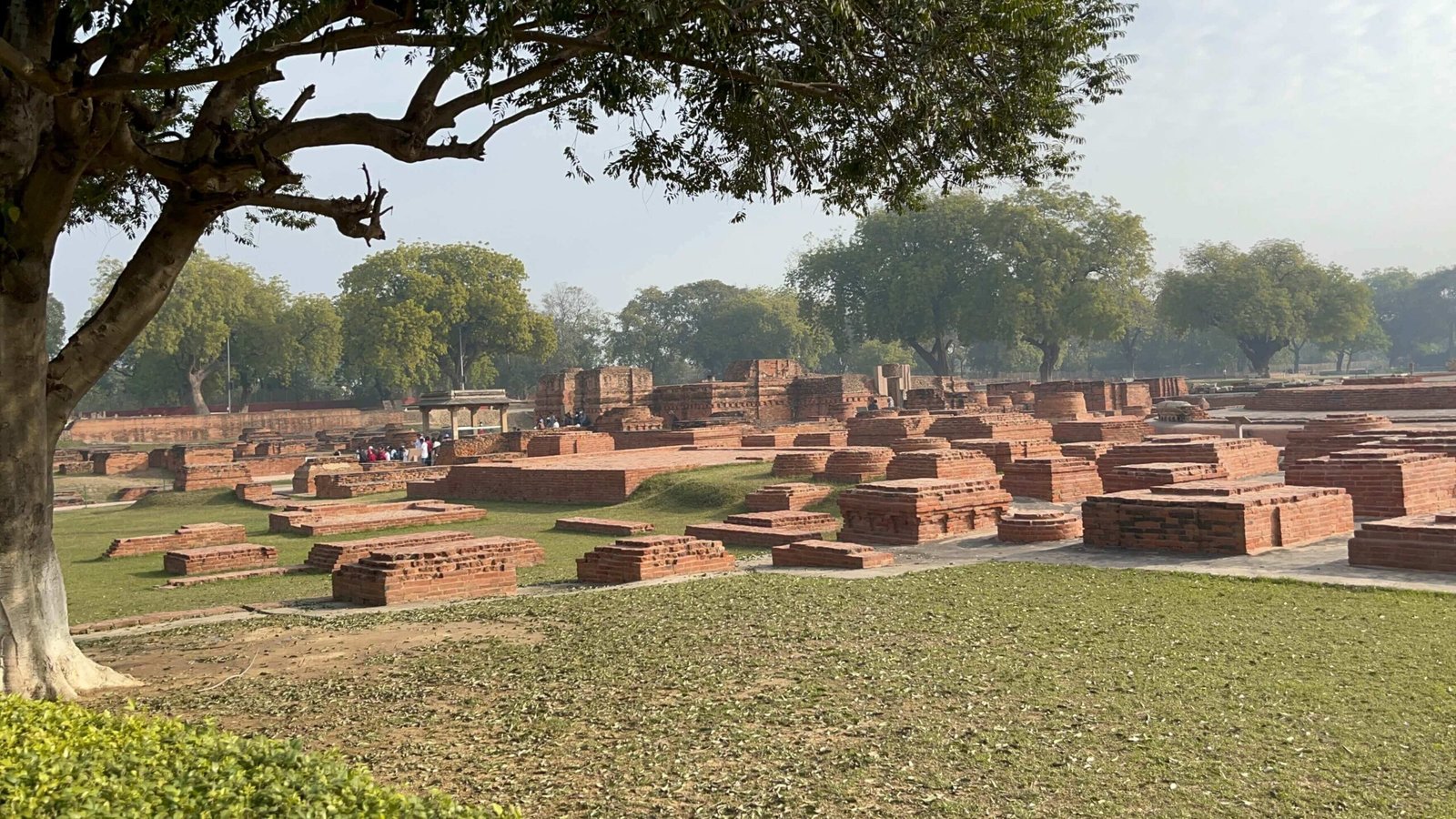
The first relic was discovered in 1913–14 by British archaeologist Sir John Marshall during excavations near the Dharmarajika Stupa at Taxila. It was found inside a small Buddhist chapel to the west of the main stupa.
The original deposit contained several nested containers. A small gold casket holding minute bone fragments was placed inside a silver vessel, which was itself enclosed in a stone container. An inscribed silver scroll accompanied the deposit.
The inscription is written in the Kharoshthi script and dates the deposit to the 136th year of the Azes era. It records the enshrinement of the Buddha’s relics by a donor named Urasaka, a Bactrian resident of Ṇoaca (also rendered Naocha).
The inscription also provides insight into the religious motivations behind the offering. Urasaka dedicated the relics in his own Bodhisattva shrine at the Dharmarajika Stupa, seeking the well-being of the Kushana king and honoring all Buddhas, other enlightened beings, and living beings, as well as his parents, friends, and relatives. The dedication also expressed his own aspirations for good health and nirvana.
Beyond identifying the donor and the purpose of the deposit, the inscription offers evidence of the practice of relic enshrinement and religious patronage in the Gandharan Buddhist world. It shows that relic offerings were not simply acts of devotion but could also express aspirations for the well-being of rulers, families, and the wider community.
The discovery was subsequently documented by the Archaeological Survey of India.
When Mulagandha Kuti Vihar opened in November 1931, the Director-General of Archaeology, Rai Bahadur D. R. Sahni, presented this reliquary to the Maha Bodhi Society on behalf of the Viceroy of India for enshrinement at Sarnath. The original outer containers had been damaged, and the gold casket was transferred into another stone container before being placed in a specially prepared reliquary. The Archaeological Survey of India’s annual report for 1930–31 to 1933–34 records this presentation.

A second discovery at Nagarjunakonda
The second relic was discovered in 1929 by A. H. Longhurst of the Archaeological Survey of India during excavations at Nagarjunakonda, an important Buddhist centre in the Krishna River valley.
The discovery was made inside the Mahachaitya, or Great Stupa. Longhurst’s excavation report describes how workers found a broken earthenware pot in an outer chamber on the northern side of the monument. Inside were a small gold box, a silver reliquary shaped like a miniature stupa, crystal beads, gold flowers, pearls, and garnets.
The gold box contained a small fragment of bone, approximately the size of a pea.
The significance of the discovery rested partly on inscriptions associated with the Great Stupa. These records refer to the deposit of the Buddha’s bodily relics, or dhātu, and identify the monument as the Mahachaitya. Longhurst identified the bone fragment as a relic of the Buddha. He also noted that the inscriptions and other evidence indicated that the people who built the monument regarded the remains as the Buddha’s bodily relics.
The original silver casket was badly damaged during its long burial. The silver reliquary now associated with the relic at Sarnath is a replica of the excavated container.
The Government of India subsequently transferred the relic to the Maha Bodhi Society for enshrinement at Mulagandha Kuti Vihar. It is now preserved alongside the Taxila relic.
Can either relic be traced to one of the Buddha’s eight original shares?
The two discoveries raise a historical question familiar to Buddhist communities: after the Buddha’s cremation, his bodily relics were divided into eight portions. Can either of the Sarnath relics be identified as belonging to one of those original shares?
The account of the distribution appears in the Mahāparinibbāna Sutta (DN 16), which describes how eight groups received portions of the Buddha’s bodily remains following his cremation at Kusinara.
The eight recipients were the rulers or communities of:
1. Rajagaha (Rajgir), representing King Ajatasattu of Magadha;
2. Vesali, the Licchavis;
3. Kapilavatthu, the Sakyas;
4. Allakappa, the Bulis;
5. Ramagama, the Koliyas;
6. Vethadipa, represented by a Brahmin;
7. Pava, the Mallas; and
8. Kusinara, the Mallas.
The Brahmin Dona divided the remains among the eight claimants. He received the vessel used in the division, while the Moriyas of Pipphalivana, who arrived after the distribution, received the ashes from the funeral pyre.
These accounts explain the traditional origin of the earliest relic stupas. However, the archaeological connection between those original deposits and relics discovered in later centuries is difficult to establish.
An early archaeological handbook published by the Archaeological Survey of India makes an important observation: none of the eight original deposits had been identified through excavation. It also describes the tradition that Emperor Ashoka collected many of the original deposits in the third century BCE, divided them into smaller portions, and distributed them among stupas throughout his dominions.
The tradition of Ashoka’s redistribution provides a historical context for the spread of Buddha relics across the Buddhist world. However, it does not establish the precise origin of every relic subsequently discovered. Establishing a connection between a particular relic and one of the original eight shares would require evidence linking it through successive stages of preservation, transfer, and re-enshrinement.
The archaeological records provide important evidence about the two deposits, but they do not establish their connection to the original eight shares. At Nagarjunakonda, inscriptions associated with the Mahachaitya refer to the deposit of the Buddha’s bodily relics. At Taxila, the inscribed silver scroll explicitly records the enshrinement of the Buddha’s relics. These records establish how the deposits were identified and understood in their respective historical contexts. Neither, however, traces the remains to any particular one of the eight original recipients.
The absence of such a historical connection does not establish that the relics are not genuine. Rather, it means that their precise lineage from the Buddha’s original distribution cannot presently be demonstrated through the available archaeological evidence. Without that evidence, assigning either relic to a specific original share would go beyond what the historical record supports.
Sarnath’s place in the history of Buddhist relics
The preservation of these two relics at Sarnath is closely connected with the work of Anagarika Dharmapala, the Sri Lankan Buddhist reformer who founded the Maha Bodhi Society of India in 1891.
Dharmapala worked to restore Buddhist pilgrimage centres in India, including Bodh Gaya and Sarnath. Mulagandha Kuti Vihar was built under the auspices of the Maha Bodhi Society at the place where the Buddha delivered his first sermon after enlightenment. Its inauguration took place on November 11, 1931.
The Government of India presented the Taxila relic to the Society for enshrinement at the new vihara. The Nagarjunakonda relic was subsequently added to the shrine’s collection. Both became objects of veneration for Buddhist pilgrims visiting Sarnath.
Their history also extends beyond India. In April and May 2018, the High Commission of India arranged an exposition of the Sarnath relics in Sri Lanka during Vesak. The Indian government described the exhibition as an expression of the shared Buddhist heritage of the two countries.
The current exposition takes place as Sarnath receives renewed international attention following its reported inscription on UNESCO’s World Heritage List in July 2026. The relics offer visitors an opportunity to encounter objects with documented archaeological histories as well as a long history of Buddhist veneration.
For historians, the discoveries at Taxila and Nagarjunakonda provide evidence of the geographical spread of relic worship and the construction of Buddhist stupas in different parts of the Indian subcontinent. For devotees, the remains preserved at Sarnath maintain a direct connection with the Buddha and the places associated with his teaching.
The distinction between what archaeological records establish and what Buddhist tradition preserves is important. The two relics have identifiable excavation histories and were both accepted by the Maha Bodhi Society as relics of the Buddha. Their connection to any particular one of the eight original portions, however, remains unknown.
The two relics preserved at Sarnath occupy an interesting place between archaeological history and Buddhist tradition. Their discoveries, inscriptions, and subsequent preservation can be traced through historical records. Their identification with the Buddha’s bodily remains, however, belongs also to the religious traditions that have sustained their veneration across generations. Whether either can be traced to one of the eight original shares remains unanswered. What their documented histories demonstrate is the enduring importance of relics in the spread, preservation, and practice of Buddhism.
Sources
1. Archaeological Survey of India — Annual Report 1928–29: Excavations at Nagarjunakonda, by A. H. Longhurst Archaeological Survey of India excavation report, 1928–29
2. Archaeological Survey of India — Annual Report 1930–31 to 1933–34 Archaeological Survey of India annual report, 1930–34
3. High Commission of India, Colombo — Sacred Sarnath Relics to Visit Sri Lanka, April 26, 2018 High Commission of India – Sacred Sarnath Relics to Visit Sri Lanka
4. Maha Bodhi Society of India — History of the Society Maha Bodhi Society of India – History
5. H. Hargreaves — Handbook to the Sculptures in the Peshawar Museum (1930) Archaeological Survey of India – Handbook to the Sculptures in the Peshawar Museum
6. Archaeological Survey of India — Excavations at Nagarjunakonda, 1927–28 ASI Annual Report 1927–28
7. United News of India — After UNESCO Recognition, Sarnath to Exhibit Buddha’s Sacred Relics from November 22–24 United News of India – Sarnath Relic Exposition
8. The Times of India — Sacred Relics of Lord Buddha to Be Displayed at Sarnath from November 22–24 The Times of India – Sarnath Relic Exposition
9. University of Sydney – Gandhāran Buddhist Texts: Urasaka – Dharmarājikā, Taxila – Silver Sheet (Azes 136) https://gandhari-texts.sydney.edu.au/edition/urasaka-dharmarajika-taxila-silver-sheet-azes-136/